
Discipleship, Featured, Theology, Uncategorized Jonathan Dodson and Brad Watson Discipleship, Featured, Theology, Uncategorized Jonathan Dodson and Brad Watson

Giveaway: Raised? Finding Jesus By Doubting the Resurrection

Jonathan Dodson and Brad Watson have written a stellar book that we want to share with you.

Raised? encourages you to doubt in order to believe. Too often Christians look down on doubt, but in Christ, we see a person who welcomes doubt and encourages faith. Jonathan Dodson and Brad Watson don’t shy away from the hard questions or settle for easy answers. They help you to see how the resurrection offers hope for the future and answers for the life and death questions we all face.

Jonathan and Brad in partnership with Zondervan were generous enough to offer 10 free copies of Raised? to giveaway for FREE to GCD readers. Below you will find a variety of ways to enter to win your FREE copy. Enter all of them for more chances to win. The contest will run until Monday, April 21st at 2PM CST. Shortly thereafter we will email the winners and announce them on Twitter.

Jonathan K. Dodson (MDiv; ThM) serves as a pastor of City Life Church in Austin, Texas. He is the author of Gospel-Centered Discipleship, Unbelievable Gospel, and Raised? He has discipled men and women abroad and at home for almost two decades, taking great delight in communicating the gospel and seeing Christ formed in others. Twitter: @Jonathan_Dodson

Brad Watson serves as a pastor of Bread & Wine Communities in Portland, Oregon. He is a board member of GCDiscipleship.com and co-author of Raised? His greatest passion is to encourage and equip leaders for the mission of making disciples. Twitter: @BradAWatson

For free resources and orders, visit raisedbook.com.

Read More
Discipleship, Featured, Theology Jeremy Writebol Discipleship, Featured, Theology Jeremy Writebol

Silent Wednesday

In the traditions of the church calendar, this week is Holy Week and today, Wednesday, is often known as "Silent Wednesday." It's called silent because in reconstructing the events of Jesus' final week before his crucifixion there doesn't seem to be any activity on Wednesday. The Gospel writers are essentially mute on the activity of Jesus' Wednesday before the cross. This might make you uncomfortable. We like God busy, God active, God at work doing things. For Americans it can be the one way we image God the best. Active, responsible, working, engaged, in charge, in control. We like to be known as responsible, busy, active people. In no way does it fit our paradigms that God would be. . . well, inactive.

There are some suggestions that Jesus continued teaching at the temple (Lk. 21:37-38) and that the religious leadership was gathered to plot against Jesus once and for all. But in the calendar of activity we're left with a gaping whole. What did Jesus say on this day? Who did he heal? Who did he confront? How did he act? What are we missing from this Wednesday?

It would be largely presumptuous of me to suggest I know what was going on that day, or why God intended it to be relatively quite in the pages of Scripture. However, the apparent mystery of this day is helpful to us in considering how to walk with Christ. It's a day of mystery, a day of silence, a day where you and I don't get the insiders look at what was happening as we do on other days. We're left, so to speak, in the dark on Jesus' actions.

The Secret Things Belong To The Lord

Are you really comfortable with that dynamic? Let me suggest it a different way; does the thought of not knowing everything that God is up to make you uncomfortable?

If I'm honest, days of silence are really troubling to me. Deep down in my heart I hate being kept out of the loop. If something is going on, I want to know about it. I want to be aware of what is on the horizon so that I can plan my steps and prepare to handle whatever it is that comes. Leave me in a situation without information and I'm very frustrated.

Times of silence from God about my circumstances are even more troubling, especially when things aren't how I envisioned them to be playing out. I want to quickly ask, "God, where are you? Give me a peek at your grand designs in this situation so that I can trust you better." Sometimes those peeks come. Often, I'm still sitting in God's silence, not privy to the information that he has.

This is profoundly frustrating to me.

If you're honest, I bet it troubles you too. We like to think that as Christians we should be in know on God's wise counsel. We might even think that if he was really wise he'd ask our opinion and get our insight so that his wise counsel is even wiser. We know our lives best, after all. It unsettles us when our favorite question, "Why?" goes unanswered.

Perhaps you are sitting in a silence-of-God situation right now. Things are difficult, they aren't what you dreamed or believed they would be or become. Life as you imagined it has turned out incredibly different and you're asking God to explain himself. Maybe you're not that deep into the conversation, but you'd like a little heads up on the events coming around the bend. The quiet of God is deafening. Sure we don't want to be know-it-alls, but we want a bit of a say on how things play out in our own lives. And God isn't answering. Days go by and we're still stuck in the silence.

It might be completely unorthodox for a pastor to say this to someone who is in the midst of God's silence, but, you need it. So do I.

The Remedy of God's Silence

As frustrating as it is to not know what God's designs or will or counsel are in your particular situations, it's also liberating. Knowledge brings with it responsibility. If I know that my car needs repair (because it won't run properly) I'm bound to get it fixed so that it does work. If I know the reasons why my current life-situation are troubling, I'm just as bound to do something about it. We want to get to work, to find a solution and fix our troubles. So as soon as God points out the reason we're enduring these troubles we're off to take care of it.

Perhaps, this is why Silent Wednesday is necessary on our calendars. Today, this day, we don't need to know the why or the what of all our situations. It's possible for us to miss out on the larger issue at hand if we know all that God knows. Instead of realizing who is really in charge we long to hear what's happening and get to work. All the while we believe that we are the one in charge.

We live in a culture that can't handle not knowing things. Just observe what occurs when you in a room talking about pop-culture facts and the question is raised that no one seems to have the answer for. Almost immediately a smart phone is pulled out, the topic in question is googled and instantaneously we have the information we lacked. We can't handle not knowing what we don't know.

This is where we have to bank on what we do know. The revelation that we do have of God anchors and helps us when we stand in the silence of not knowing what he is doing. Tim Chester is helpful in identifying for us the “4 Gs” of God's nature and character so that when we are stuck in the silence we can hold on to the reality of who God is despite not knowing what he is up to or why things are going the way they are.1

We are reminded that:

1. God is great–so we don’t have to be in control.

2. God is glorious–so we don’t have to fear others.

3. God is good–so we don’t have to look elsewhere.

4. God is gracious–so we don’t have to prove ourselves.

If we don't anchor ourselves to the revealed knowledge of God and his identity, we will struggle along trying to come up with answers and realities that might counter the very thing that God is showing us in his silence. When we are in situations where we do not know what's going on, we need to look to what we do know, namely God's character, so that we can walk well through the trial of his silence.

Trusting a Quiet Father

As a boy my parents would sometimes take my brother and I up into the mountains of Colorado to go off-roading on our four-wheeled ATV's. As small children, we loved the exhilaration of being out on the trail, seeing nature, strolling over difficult terrain, and ending up in places where not too many human beings had ventured before. But there were always a few times when I was completely terrified. We'd roll right up to the edge of a cliff for a look-over or find some wild trail that was absolutely frightening to venture on. I was scared out of my mind on several occasions.

I don't, however, remember my dad always telling me why we were on those trails or in those spots. I do, however, fondly look back on those difficult places that we were in knowing that my dad was never going to put me in a situation that would ultimately injure me. My father is a good father who cared well for his sons.

So how much so does our Heavenly Father care for us, even when he isn't giving us the answers or the information. Even when he walks us into the wilderness without any knowledge of why we are there, we have to remember that he is utterly trustworthy.

I have to wonder if the Wednesday of Holy Week was like that for Jesus. The Scriptures record nothing of that day. It's likely that they are telling us that even when we don't know what is going on God does, and he has ordained all things for our good and for his glory.

Jeremy Writebol(@jwritebol) has been training leaders in the church for over thirteen years. He is the author of everPresent: How the Gospel Relocates Us in the Present (GCD Books, 2014) and writes at jwritebol.net. He lives and works in Plymouth, MI as the Campus Pastor of Woodside Bible Church.


1. Tim Chester, You Can Change, Crossway Books

Read More

A Season to Fast and Pray

Lent is a time for prayer and fasting. It is a season of spiritual preparation in which we remember Christ’s temptation, suffering, and death. Historically, the church has celebrated Lent as a 40-day period beginning on Ash Wednesday and concluding the day before Easter. It is observed in many Christian churches as a time to commemorate the last week of Jesus’ life, his suffering (Passion), and his death, through various observances and services of worship. Many Christians use the 40 days of Lent as time to draw closer to the Lord through prayer, fasting, repentance, and self-denial. We live in a culture of fast food, instant gratification, and self-centeredness. One of the best ways to get our eyes off of ourselves and back onto the Lord is through fasting. However, fasting has practically been disregarded and forgotten in the comforts of the modern church. Fasting didn’t end in Biblical times, there have actually been proclaimed fasts in America. Fasting is nothing new in American history. The pilgrims held three formal periods of fasting before leaving for the New World. During the American Revolution, the Continental Congress proclaimed July 20, 1775, as a national day of fasting and prayer in preparation for the war on independence.

What is Fasting?

What does it really mean to fast? According to the Oxford Dictionary, fasting means to abstain from food; especially to eat sparingly or not at all or abstain from certain foods in observance of a religious duty or a token of grief.” Fasting and religious purposes cannot be separated because they are intricately intertwined. The Bible gives us numerous references to individual and corporate fasts. There were even certain days that were designated each year for fasting and prayer. Fasting is a gift that God has given to the church in order to help us persevere in prayer. Fasting draws us closer to God and gives power to our prayers. Our central motivation with this lesson is to teach about the reasons to fast, different types of fasting, and then discuss how to fast.

Reasons for Fasting

People have been fasting since the ancient days of the Bible. The Bible records numerous accounts where people, cities, and nations have turned to God by fasting and praying: Hannah grieved over infertility “wept and did not eat” (1 Samuel 1:7); Anna, who was an elderly widow, saw Jesus in the temple and “served God with fasting and prayer” (Luke 2:37). Saul encountered Jesus on the road to Damascus, “was three days without sight, neither ate or drank.” (Acts 9:9). Cornelius told Peter, “Four days ago I was fasting until this hour…” (Acts 10:30). Most people fast for religious and spiritual reasons, while others choose to fast for health reasons. There are several specific reasons that the Bible tells us to fast.

  1. To be Christ like. (Matthew 4:1-17; Luke 4:1-13).
  2. To obtain spiritual purity. (Isaiah 58:5-7).
  3. To repent from sins. (See Jonah 3:8; Nehemiah 1:4, 9:1-3; 1 Samuel 14:24).
  4. To influence God. (2 Samuel 12:16-23).
  5. To morn for the dead. (1 Samuel 31:13; 2 Samuel 1:12).
  6. To request God’s help in times of crisis and calamity. (Ezra 8:21-23; Nehemiah 1:4-11).
  7. To strengthen prayer. (Matthew 17:21; Mark 9:17-29; Acts 10:30; 1 Corinthians 7:5).

Types of Fasting

In the same way that God appointed times and seasons to fast, He also designated several types of fasts. Because of certain medical problems, and physical needs, there are different types of fasting. Not everyone can go on an extended 5-7 day fast; in a similar way, not everyone can totally abstain from food and water. A person should exercise wisdom and consult their physician if they have any medical concerns before they fast, otherwise it could actually be harmful to your health. However, there are at least three types of individual fasts: absolute fast, solid food fast, and partial fast.

1. Absolute Fast

An absolute fast is conducted by abstaining from all food and water for a certain period of time. This is also known as the “total fast” because an individual chooses to abstain from all foods and beverages. There are several Biblical examples for the total fast. Moses and Elijah both abstained from food and water for forty days and forty nights. (Deuteronomy 9:9, 10:10, 18:25-29; 1 Kings 19:8). Although the Bible says they fasted for forty days, many people usually only totally abstain from food and water for three days.

2. Solid Food Fast

A solid food fast is where an individual may drink juice and water, but chooses not to eat solid food. Certain scholars and theologians think that Jesus may have drank water while in the wilderness since the Bible doesn’t say that he was thirsty after his forty day fast (see Matthew 4:2). Drinking water while fasting for several days can actually be therapeutic for your body. In any case, you should not fast for more than a week unless you consult a doctor.

3. Partial Fast

To fast simply means to “abstain” from something. A partial fast is where you choose to abstain from certain foods and drinks instead of complete abstinence of food or drink. The Bible tells us that Daniel abstained from bread, water, and wine for twenty-one days (Daniel 10:3). Others may choose to fast from television, computer, newspaper, and hobbies. This will help you free up some time to spend in prayer and reflection.

Jesus and Fasting

In the Sermon on the Mount, Jesus taught a lesson about how to fast and how not to fast:

“Moreover, when you fast, do not be like the hypocrites, with a sad countenance. For they disfigure their faces that they may appear to men to be fasting. Assuredly, I say to you, they have their reward. But you, when you fast, anoint your head and wash your face, so that you do not appear to men to be fasting, but to your father who is in the secret place; and your father who sees in secret will reward you openly.” (Matthew 6:16-28)

We see that it is important to not brag or boast to others about fasting. The Jews of Jesus’ day used fasting and giving to make everyone think that they were more spiritual than others. But Jesus tells us that fasting should be done in secret so that it can’t be used as a way of bringing glory to ourselves. Fasting should make us humble instead of proud. In the end it is not our works, but our hearts that matter to God.

Dr. Winfield Bevins serves as lead pastor of Church of the Outer Banks, which he founded in 2005.  His life’s passion in ministry is discipleship and helping start new churches. He lives in the beautiful beach community of the Outer Banks with his wife Kay and two daughters where he loves to surf and spend time at the beach with his family and friends. Twitter: @winfieldbevins

(Editor’s Note: This is an excerpt from Prayer Life by Winfield Bevins available through GCD Books.)

Read More
Discipleship, Featured, Theology, Uncategorized Anna-Maeve Martin Discipleship, Featured, Theology, Uncategorized Anna-Maeve Martin

Love Actually

When blogging about the Christian worldview and framing apologetic arguments, there is typically (at least, there should be!) a heavy dose of truth involved. But what does Paul mean when he admonishes us to "speak the truth in love”? Paul makes an important point here, the subtlety of which can be easily missed. The obvious response to this verse would be: "Well, Paul is saying we shouldn't bash people over the head with the truth because that wouldn't be loving." This is true, but I think it goes deeper than that. I think it's worth exploring some further questions.

What does Paul mean by love?

It is useful to view Paul's statement in the context of Jesus' teaching: the first and greatest commandment is "Love the Lord your God with all your heart and with all your soul and with all your mind" (Matt. 22:37) and the second is "‘Love your neighbor as yourself'" (Matt. 22:38). If we consider Paul's statement in light of these two commandments on which "all the Law and the Prophets hang" (Matt. 22:40), we can deduce that Paul is telling us to speak the truth as an outworking of our love of God and of people—not as a result of our love of the world, our love of popular approval, or our love of ourselves.

The Greek term for love Paul uses here is agape, a form of agapeis, which is also used by Jesus (agapaō) when he quotes the greatest commandments. The essence of agape is self-sacrifice. So then, speaking the truth should be done in self-sacrificial love as modeled by Jesus Christ. First, it should be to glorify God, and, second, to edify those who hear it. And speaking the truth may also be costly to us, costing us things like convenience, popularity, friendships, even our safety.

The Holy Spirit empowers us to love God and love others in a self-sacrificial way. Loving others without the Holy Spirit involves a self-serving, consumeristic form of love that actually takes away from God and other people more than it gives. This may not be immediately evident when we observe acts of love that are done in human strength such as generosity, kindness, or charity. Humans are created in the image of God, so in some ways we gravitate toward the notion of doing good unto others.

But, loving others in our own strength as well-intended as it may be, ultimately ends up being self-serving because of our fallen nature. Loving others certainly can provide us with a whole lot of earthly perks: a warm and fuzzy feeling, popularity and a good reputation, a wholesome family environment, a better marriage, or a safer community to live in. Loving others in our own strength, however, hardly ever leads us to speak the truth in love because it isn't God-honoring. Instead, it's more likely to make us smooth things over so things will be more comfortable for everybody. It can lead us to ignore inconvenient truths and live in denial. It can lead to double-mindedness, flattery, and people-pleasing. Living in the power of the Holy Spirit, on the other hand, gives us a supernatural ability to genuinely love others sacrificially. Christ-like love, however, is often rejected by the world and doesn't come with all the earthly perks we might desire.

What does Paul mean by truth?

We can see from the passage above, that the alternative to speaking the truth in love is spiritual immaturity (being like "infants") and susceptibility to being "tossed back and forth by the waves," to being deceived by every wind of teaching and the deceitful scheming of other people (Eph. 4:14-16). Paul, then, is urging us to teach others to obey God's commandments so that they will not be caught up in circumstances or be deceived by false teaching, but will instead be anchored in the truth so that they will mature and be built up in the Body of Christ.

This is the essence of discipling others, just as Jesus articulated before His ascension to heaven. He says, "Go and make disciples of all nations, baptizing them in the name of the Father, and of the Son, and of the Holy Spirit, and teaching them to obey everything I have commanded you" (Matt. 28:19-20). Teaching the truth about God's commands as laid out in his Word is an integral part of discipling others and building up the Body of Christ.

Paul admonishes believers to handled the "Word of truth" accurately (2 Tim. 2:15). Paul makes it clear that the only way to do this is to understand that it’s in Christ alone in whom all truth is rooted. Speaking truth about the law like the Pharisees did is not what Paul means by handling the Word of truth accurately.

Paul resolved to "boast in nothing except in the cross of our Lord Jesus Christ, through which the world has been crucified to me, and I to the world." (Gal. 6:14). While Paul stays with the Corinthian believers, he describes how,

"When I came to you, I did not come with eloquence or human wisdom as I proclaimed to you the testimony about God. For I resolved to know nothing while I was with you except Jesus Christ and him crucified. I came to you in weakness with great fear and trembling. My message and my preaching were not with wise and persuasive words, but with a demonstration of the Spirit’s power, so that your faith might not rest on human wisdom, but on God’s power." (1 Cor. 2:1-5).

Speaking the truth, then, must be Christ-centered—not relying on human wisdom, but on the power of God. Because speaking the truth in love rejects human wisdom, and centers on the stumbling block of Christ, it may be offensive others.

What does Paul mean by "in"?

The little word "in" carries a lot of weight here. Paul's admonishes us to speak the truth "in" love. He doesn't talk about speaking the truth "with" love or speaking the truth "about" love.  I think there is a subtle but significant distinction here.

First, loving actions and behavior towards others should provide the backdrop for speaking the truth. Young Life's founder, Jim Rayburn, talks about "earning the right to be heard" when ministering to young people and sharing the gospel with them. The gospel is best communicated within a context of friendship or service. I think Paul is saying something similar here: the truth is better received when it's delivered within the context of Christ-like love.

Interestingly, Paul didn't say speak love, he said speak truth. He isn't talking here about love as the content of what is being spoken. Have you ever heard the saying, "actions speak louder than words"? Simply saying nice things to someone without backing up our words with loving actions is disingenuous. Speaking words of love alone, can quickly turn into flattery and empty words. Love is more authentically demonstrated in the way we treat others. In other words, we need to aim at doing love, and speaking truth in a way that honors God first and foremost.

Second, our motive for speaking the truth should be rooted in our love of God and our love of people. The fact is, if we truly love someone, we will want to be honest with them. If you saw someone you loved self-destructing, you would do what you could to save them. In actuality, the only life-preserver that will save someone who's spiritually drowning is the gospel. This should be our motivation behind speaking the truth: to help others find the Way--Christ Jesus.

Keeping our motives pure can be costly. It can cost us friendships, popularity, and convenience. I am a people-pleaser by nature and as a result I am constantly struggling with the temptation to do and say things I think will make people happy or make people like me more. At times, it has been tempting for me to make a friend feel better about a problem they are having, rather than speaking the truth to them about their situation. The truth can make us uncomfortable. This can lead us to brush it under the rug, or tell ourselves a different, more palatable story. In doing this, however, we put our feelings before our obedience to God.

Finally, Paul shows that Christ-centered truth is inseparable from Christ-like love. As demonstrated above, love without truth is people-pleasing. But just as dangerous is truth without love, which can lead to hard-headed legalism, hatred, and division. Truth without love is like faith without deeds. And we know from James that faith without deeds is dead. "Show me your faith without deeds, and I will show you my faith by my deeds. You believe that there is one God. Good! Even the demons believe that—and shudder" (Jm. 2:18-19).

Head-knowledge alone doesn't save us, for even the demons know the truth. I have known people who have a keen grasp of theological concepts and can even articulate the atonement, for example, with amazing precision. However, their hearts have been unchanged by the gospel. Head-knowledge alone doesn't change the heart. We know from Scripture, "knowledge puffs up while love builds up" (1 Cor. 8:1). Head-knowledge can be a source of pride—an unhealthy form of self-love that turns us away from God. If we don't experience heart-change in response to the truth of the gospel, our faith is dead.

Essentially then, love and truth are interdependent. Truth is, by its very nature, completely submerged and saturated in love! God is love (1 Jn. 4:8), just as he is truth (Jn. 14:6). And the truth of the gospel of Christ is the purest expression of love. In other words, in Christ, love actually is truth. And love and truth are an integral part of discipleship.

As Paul shows us, speaking the truth in love is key to establishing unity in the Body of Christ. This is because what unifies us as believers is not brushing fundamental truths under the carpet to keep the peace, but rather upholding the Gospel of Christ in our churches and uniting together in the name of Jesus. Paul explains that with Christ as our Lord, believers will be united together, speaking the truth in love, as we "grow up in every way into Him who is the head," which allows the Body to "build itself up in love" (Eph 4:15-16).

_

Anna-Maeve Martin has worked in international development, civil liberties, and church ministry (missions & outreach). She has two Master's degrees in History of Ideas (Leeds University, UK) and Government (University of Pennsylvania) and continues her studies at Southern Baptist Theological Seminary. She is originally from England but now resides in Northern Virginia where she is a stay-at-home mom of three young daughters by day and a blogger by night at Faith Actually. Follow her on Twitter @FaithActually.

Read More
Book Excerpt, Discipleship, Featured, Missional, Theology Jeremy Writebol Book Excerpt, Discipleship, Featured, Missional, Theology Jeremy Writebol

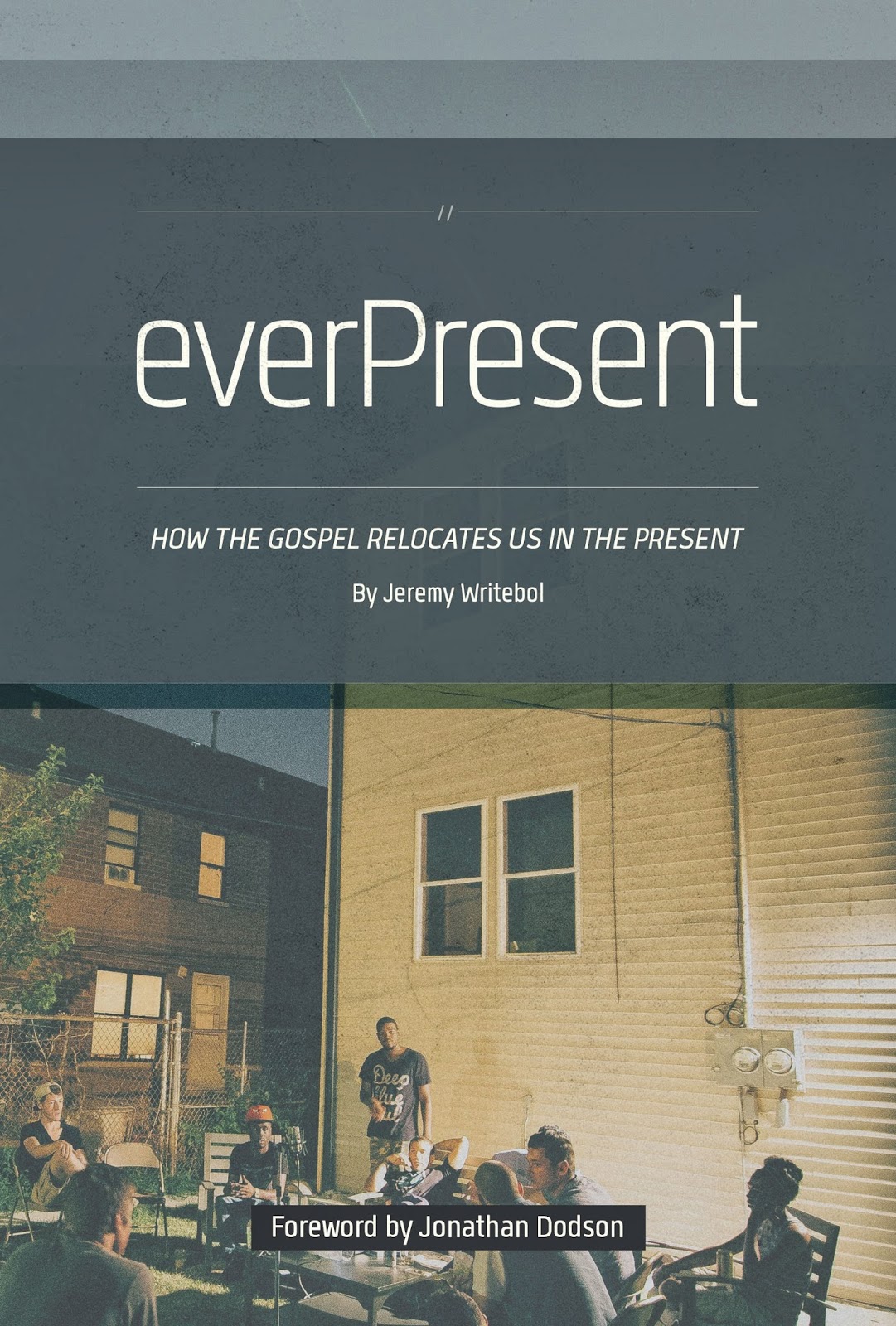
New GCD Book: everPresent: How the Gospel Relocates Us in the Present

Today, we release the newest eBook from GCD Books--Jeremy Writebol’s everPresent: How the Gospel Relocates Us in the Present. You can buy a digital copy from the GCD Bookstore for $4.99 or get a paperback from Amazon for $6.17. Here’s an excerpt:

Where are you right now? Take a moment and look around...

As I write, I am sitting in a café on Bitting Avenue. I can smell the aroma of roasted coffee. I can hear the patrons of the shop discuss their lives, what they will see on TV this evening, the rise and fall of the economy, and who will win the Super Bowl. I feel the warmth of a heater turn on as it is an unusually cold day. Light streams in from the front windows and illuminates the orange walls to bring a warm, homey ambiance to the room. Latin American guitars and beats fill my ears as the music from the café stereo plays. The apple-carrot coffee cake I am eating has a sweet, buttery flavor to it. The padded chair where I am sitting keeps me comfortable but awake. Right now, I am in a place. There are specific and unique events happening in this space that are not occurring simultaneously anywhere else in the universe. This place is special. This place is one of a kind. This place is the only place where I can be in the world right now.

This is not true of God. The Bible tells us that God fills heaven and earth (Jer. 23:24). It says that the highest heaven is not large enough to contain God (1 Kgs. 8:27). Nor is there a single place in the entire universe where a human can go and God not be present (Ps. 139:7–10). The word "omnipresent" sums up this spatial reality of God. He is present everywhere, all the time, in every way. He is not limited by anything and is fully present wherever he is, which is everywhere. Maybe we should venture down the path of comparison. We’ll start with God. He is immense and infinite. He alone can be spatially present everywhere all the time. You and I, on the other hand, can’t even exist in two places at once. This comparison can be helpful to put us in our place.

But we need more than just a reminder of how ant-like we are. We need to see the importance of our limitation and the uniqueness of our specific place. We need to see that we are inferior to God in our inability to be everywhere present. And yet the places we inhabit, and specifically our presence in those places, has deep importance. Maybe we do need to be put in our place. What if being "put in our place" isn’t about being humbled to insignificance but elevating our vision to see dignify the places we inhabit; to see that our presence is valuable and deeply important. We need to talk about God’s space and place.

The Creation of Place

As I sit here at the café, I am privy to some special things: color, taste, smell, feeling. I can see two musicians meeting with a local artist to discuss album cover designs. Various cars drive by in front of me. Occasionally, I see a biker, although the winter cold prevents this from happening too frequently. This is a very unique place. It is a very creative place.

Who made it? Why was it made? If we ignore the Biblical story, we don’t have great, cosmic answers for these questions. But if we look at the opening pages of Scripture, we have a fascinating drama unfolding before us. The first words of divinely inspired writing from the pen of Moses declare that in the beginning, God made the heavens and the earth (Gen. 1:1). Location is created. All of a sudden there is the creation of "place." Place alone, however, is boring. We have heaven and earth. Two categories, two ideas, but not really specific realities. The story continues to unfold.

God doesn’t just make categories; he creates places. The earth is filled with vegetation, inhabitants, colors, creatures, textures, liquids, solids, atmospheres, environments—places. The specific place called the Garden of Eden is unique. There are places within the Garden. A river flows through the Garden. The middle of the Garden has specific and diverse vegetation. Four rivers diverge from the main river on the outskirts of the garden. They flow to places with specific names and specific features. Some of those places have gold, some have precious gems. Each distinct. Each unique. Each a special place.

God, who cannot be limited by place, creates multiple locations. He makes places. Each of them are as unique and varied as he is. All of them created good. All of them beautiful. All of them reflecting and imaging his creativity and his diversity. Why does he make these distinct places? He makes them for himself. He creates all the diversity of place and location, with all its varied colors and dimensions, to display his varied and multi-colored glories. The song at the end of the Scripture story sings praise to God because he has "created all things and by [his] will they existed and were created" (Revelation 4:11). The everywhere-present God makes places because he can’t help himself. Place is an overflow of his creative glory. Worship is our response.

Does Place Matter?

Why does all this matter? Since showing up at this specific café, I have noticed the flow of traffic in and out of the store. The aromas that exist in this room now are especially different than the ones that were here a few hours ago. The sounds are new, different, exciting. The musicians are playing their guitars and harmonicas now. It is a new and different place than the one that existed an hour ago. This place is unique and one-of-a-kind again.

Place or location is created by God for his glory. That means that everywhere we go, every location we inhabit, every neighborhood where we dwell is made for God. It shows us a multi-faceted and creative God, a God who is so unique and innovative that one specific location alone could not reflect his glory well. Each place sings the glories of God. Each location tells of his wonders. Each address displays his majesty. Does place matter? On every level, it inherently must.

The way the glory of God is seen at the Grand Canyon is different than the way his glory is seen on Bitting Avenue. The majesty of God takes on a different view in Mumbai, India than it does in London, England. The worship of God sounds different in the jungles of Ecuador than it does in the high rises of New York City. Yet each place is made by his will and for his glory. Each place has a specific role to play in declaring the glory of God, and no one place holds a monopoly on the display of that glory.

This isn’t to say, in some sort of pantheistic way, that God is in everything or that we each have to find our own way of expressing him wherever we are. Just as a diamond will refract light differently in different places, so God’s glory is seen differently in different places. Some places reveal it better than others. We cannot dismiss the broken and dark places of this world. They do not reflect the glory of God well. It is difficult to see the mercy and justice of God in the slums of Rio or the prisons of Iran. Not every place seems like it is God’s place. This is why there must be restoration. If every place is made by God, for God, then the broken places that do not reflect God’s glory must be restored. It’s for this reason that every place matters.

If all things are created for his glory and if all places should uniquely reflect the varied glories of God, then we are called to see our places (including our workplace) as places of worship. Our specific place becomes uniquely important to our lives because it is from this place, and this place alone, that we can magnify God and bring glory to him. I look at my friendly café and I wonder: “How is God’s presence displayed here? How is this place reflecting his glory? Where do I see his fingerprints of majesty? Does the coffee, the conversation, the art, and the atmosphere reflect anything of God’s nature and glory?”

Take a moment and look around (once again) at the place you are inhabiting as you read this sentence. How does this place glorify and magnify God? How does it reflect his multi-faceted nature? What do you see?

God has created this very place where I am writing. He has created the very place where you are reading. He has created it by his will. He has created it for his glory. Now, you might challenge that statement because you know some architect drew up the design for this building and a contractor came in and had carpenters, builders, electricians, and plumbers actually make this place. But under God’s authority, using the agency of humanity, he created and holds all things together (Col. 1:15). Place matters because God made it matter. You might feel indifferent to this place right now because it isn’t where you want to be or because it is somehow broken and in disrepair. This place might be a comfortable, quiet place for you right now. It might be a place that doesn’t belong to you; you are a visitor in it for only a season. Whatever the situation, because God has made it and made it for his glory, you are suddenly in God’s place.

--

Jeremy Writebol(@jwritebol) has been training leaders in the church for over thirteen years. He is the author of everPresent: How the Gospel Relocates Us in the Present (GCD Books, 2014) and writes at jwritebol.net. He lives and works in Plymouth, MI as the Campus Pastor of Woodside Bible Church.

Read More
Featured, Theology Dustin Crowe Featured, Theology Dustin Crowe

7 Ways the Father Loves Us

It’s remarkable how difficult it can be to let ourselves be loved by God. For many of us, the love of Jesus comes through loud and clear, but God the Father often seems distant or looming. Many of our perceptions of God have been distorted by earthly shadows—fathers, employers, leaders, etc. To move forward in loving and being loved by God, we must replace our false ideas with biblically-saturated truth. God’s attributes—including love—aren’t like human traits that strengthen or weaken nor are they like moods that come and go. God is all of his attributes perfectly, all the time. And yet, we still struggle to believe it can be true, that this great God can love us messy and stumbling sinners. Sometimes we don’t feel his love on a day to day basis like we desire, so walls of doubt begin to shut him out. Other times we unwittingly read the Word not through the lens of his love and grace to us in Christ, but through tinted lens of condemnation and guilt.

My hope is that by dwelling on God’s love for us, we’ll move from a general and vague idea to a sweet and personal experience. God desires as much, and once the fountain of the Father’s love is opened we’ll find ourselves stepping into new streams of gratitude, contentment, joy, and security. Here are seven examples from the New Testament of how God clearly and convincingly displays his fatherly love to his children.

1. The Father’s Love in Sending

“For God so loved the world, that he gave his only Son.” (John 3:16)

The Father’s love for us is nowhere more conspicuous than in the sending of his only Son—freely, unprompted, and undeserved. The same Scriptures proclaiming Christ’s love in dying also reveal the immense love of the Father as the sending source. He so loved us that he gave his only begotten Son. This world-famous verse placards the pursuing love of the Father. And it’s not a nebulous or general love, but his particular love to actual persons like you and I.

Whether from the lies of the accuser or deception from our own minds, Christians can act as if Jesus is the good guy who convinces the fear-inducing Father to show mercy. In reality, the Father dearly wants to be in an intimate relationship with us so he dispatches the Son to bring us back. This unmerited love of God shines even brighter against the backdrop of our dark and ill-deserving condition.  That’s why the Apostle John erupts with the words, “Here is love!” when he thinks about the Father giving Jesus to bring wayward children into his family. “In this is love, not that we have loved God but that he loved us and sent his Son to be the propitiation for our sins” (1 John 4:9-10). The cross is the exclamation and the evidence of how much the Father loves us.

2. The Father’s Love in Revealing

“And whoever sees me sees him who sent me.” (John 12:45)

As the Word, Jesus is the self-expression of God. The incarnation points to the Father’s love because it proves he wants to be known in a way that is clear, intimate, and according to truth. Because God is not like us in so many ways and cannot be seen or touched there are moments he might seem remote or intangible. Jesus takes our vague or slightly distorted notions of God and gives us the real picture of the Father in his fullness of grace and truth. We should look to the incarnation of Jesus to see just how near the Father has come. The Son shows us the Father, and through Jesus the invisible God is finally visible.

It should astound us that the infinite, transcendent, and perfect God would make knowing us and being known by us one of his highest priorities. What a joy that God is a Father who doesn’t just show mercy—and that would be wonderful enough—but he wants a real relationship where we know and love him. Our perceptions of God become fuzzy and distorted when we look at earthly figures of fathers or authorities. However, when we look at Jesus the character and compassion of the Father is clearly and accurately put on display.

3. The Father’s Love in Adopting

“See what kind of love the Father has given to us, that we should be called children of God.” (1 John 3:1)

God the Father’s love can be seen in the friendly and familial vocabulary describing a believer’s relationship with God. We are called his sons and daughters. God wants to be known and seen in this way which is why he draws on the affectionate language of Father and children. “And because you are sons, God has sent the Spirit of his Son into our hearts, crying ‘Abba! Father!’ So you are no longer a slave, but a son” (Gal. 4:4-7). Paul was well aware how quickly we retreat back to fearing God as slaves so he presses home the truth we can trust Him as children.

Imagine two people in your mind’s eye. First, imagine someone you feel comfortable with because you’re loved and accepted. When with them you don’t ever have to worry about being anything other than yourself. Now visualize a second person who creates an uneasy sense of the need to measure up or being on your best behavior. Think of the difference if you were just sitting in your living room with either person watching TV together or talking. How free do you feel with the first person versus how hesitant or anxious you feel with the second? Because of our justification in Christ, the Bible describes God the Father as the person in the room we should completely trust and therefore find rest with—awake to the fact we are truly known. The Father doesn’t hold back love until we change or earn it. It’s a full stream of God’s unconditional love to his children.

4. The Father’s Love in Comforting

“Blessed be…the Father of mercies and God of all comfort.” (2 Cor. 1:3)

The Father expresses his love in the comfort he gives, and even in the fact he calls us to find our comfort in his fatherly embrace. “Blessed be the God and Father of our Lord Jesus Christ, the Father of mercies and God of all comfort” (2 Cor. 1:3). It’s a slightly different nuance but in Romans 15:5 Paul also calls him the God of encouragement. He doesn’t turn his children away or pile up heavy discouragements on their backs. He’s not looking to criticize you or asking you to toughen up. Instead, he’s a gentle God who gives the comfort we need when we hurt and the encouragement we need when weary.

The discomforts in this world are no match for the comforts of our Father. He wraps his strong but soothing arms around us. The comfort of the Father never goes away. It is not wearied or exhausted by our sins and it isn’t based on our performance. The Father comforts because he is the God of comfort. His love is seen both in the act and in the warm heart that calls us. We might imagine God with arms crossed ready to criticize or condemn, but God assures us that he stands with arms opened ready to welcome and console us.

5. The Father’s Love in Giving

“Every good and perfect gift is from above, coming down from the Father.” (Jam. 1:17)

The Father loves us by giving good gifts. He enjoys us enjoying him as we enjoy his gifts. This exhibits his care and provision for us but it also expresses his generous and glad heart towards his children. God hands out who knows how many gifts to us each day, but the problem is we either don’t see the gifts or we don’t stop to consider who they’re from. Gratitude happens when we open our eyes to an awareness of the gifts and then raise our eyes in a response of thanksgiving to the God who gave them. Our joy in gratitude becomes the joy of worship. The gift should always lead to the giver. David Pao says, “Thanksgiving in Paul is an act of worship. It is not focused primarily on the benefits received or the blessed condition of a person; instead, God is the centre of thanksgiving.”[1]

Jesus argues from the lesser to the greater to bring home the reality of God’s goodness. “If you then, who are evil, know how to give good gifts to your children, how much more will the heavenly Father give the Holy Spirit to those who ask him” (Luke 11:13). The best examples of earthly fathers in their generosity and gifting are a tiny picture of God’s perfect love. God has blessed us with innumerable blessings, and the more we see them as gifts the greater opportunity we have to delight in the Father. In other words, one way to see God’s heart of love for us is to see the gifts that come from his hand to us.

6. The Father’s Love in Promising

“For all the promises of God find their Yes in [Jesus Christ].” (2 Cor. 1:19)

The Father’s love is seen in the making and fulfilling of promises to his people. All God’s promises to us are confirmed and secured in Jesus (2 Cor. 1:19). First, he loves us by being true and faithful rather than being unreliable or deceptive (Titus 1:2). Nothing gives a greater sense of safety and security than a trustworthy father. Second, he demonstrates his love in the promises themselves. He keeps his word and he offers some pretty amazing blessings. he promises to love us as his own children, to give us his Holy Spirit, to keep us secure in Christ, to wipe away our sins, and to one day come back and restore all things (see Eph. 1:3-14).

The Bible is stocked full of promises that are strong enough and sweet enough to carry us through each day. Promises are God’s caffeine kick to reawaken and energize Christians. One of the best things to do when studying God’s Word is to intentionally pick out the promises of God and to anchor your life on them. They are true and they are good. If we ever doubt God’s promises he calls us to look back to the pledge of his Son (2 Cor. 1:20; Rom. 8:31-39) and the down-payment of his Spirit (2 Cor. 1:22; Eph. 1:14). God loves us by promising us with countless blessings and assurances, and he loves us by always keeping those promises.

7. The Father’s Love in Disciplining

“For the Lord disciplines the one he loves.” (Heb. 12:6)

The Father loves us not despite discipline but through it. I know this point is a hard sell but the Bible connects the dots. God’s discipline is a calm but firm correction, never a fit of rage. He aims to teach us not reject or punish. The NT links discipline and love to help cement in our mind that they’re not irreconcilable enemies, but rather, they’re actually related (Heb. 12:3-11; Rev. 3:19). The fact that God corrects his children should encourage us just how much he cares and provide proof he will never give up on or leave us in our sin.

A beautiful scene in the TV show “Parenthood” depicts this idea. One of the families had adopted an abandoned young boy. Early on he misbehaves and continues acting out his bad habits. The mom thinks they should keep looking the other way but the dad reminds her they’re his parents now. He’s their child so they need to treat him like family, not like a guest or stranger. Since he’s now their boy and they want what’s best for him they make the tough choice to give correction and explain what he’s done wrong. As God’s children, we also need to remind ourselves that discipline isn’t the same as displeasure. In fact, it demonstrates God’s commitment to us. God treats us not as strangers or guests who he has no relationship with but as a father who deeply loves his sons and daughters.

Loving How We’ve Been Loved

When we don’t live in light of God’s love for us we’ll either shy away from Him out of fear or exhaust ourselves trying to win his approval. My hope is that as we let the truth of God’s love drip from our heads to our hearts we’ll be refreshed in security and rest. This is a game-changer when it comes to how we draw near to our God. It also transforms relationships and how we treat one another. As we experience the Father’s love in specific ways, we can give the type of love we’ve received.

There are a lot of great insights out there on parenting and marriage, but we cannot love children or spouses well unless the perfect love of the Father is a first-hand experience. In a culture desperate in its desire for “true love” and yet clueless in what that looks like, both single and married Christians can point others to a satisfying, unending love their souls are aching for. The application could be extended to the hard people in our lives or the unlovely in our families and neighborhoods, but in each case we can only love others well as we see them through the lens of how God has loved us: freely, undeservingly, and steadfastly.

_

Dustin Crowe has a bachelor’s degree in Historical Theology from the Moody Bible Institute and studied at the master’s level at Southern Seminary. He is Local Outreach Coordinator of College Park Church, a church of 4,000 in Indianapolis, where he also helps with theological development.


[1] David Pao, Thanksgiving: An Investigation of a Pauline Theme (Downers Grove: InterVarsity Press, 2002), 28-29.

Read More
Featured, Identity, Sanctification, Theology Luma Simms Featured, Identity, Sanctification, Theology Luma Simms

How Our Union with Christ Defines Us

Every day, men and women get bombarded with ideas, subtle and obvious, on who they should be. The messages are mixed and they come from all corners. Whether it's the culture of the world or the culture of the Church (and the countless veins within each), the propaganda and advice can be dizzying and confusing.

I am convinced that the breakdown in our understanding of Christian human identity today is a lack of understanding and living out of our union with Christ. Setting aside the gender issues, there is one answer which Scripture gives us to the question of identity for men and women: to be conformed to the image of his Son (Rom. 8:29).

We may have many earthly identities: single, married, husband, wife, mother, father, daughter, son, friend, butcher, baker, candlestick-maker, etc. However, there is a wider and deeper reality than all of this: a Christian man or woman is in union with Christ. A Christian man or woman is in Christ. That is our reality. It is Christ who defines personhood.

New Life in Christ

As a first principle, this is where we need to start as Christian humans. All thought, and the subsequent actions from that thought, should come from our union with Christ: "Therefore, if anyone is in Christ, he is a new creation. The old has passed away; behold, the new has come" (2 Cor. 5:17).

Let me give an example (and there are countless others) of how our understanding of our union with Christ affects our everyday life. As a wife, I submit to my husband according to Ephesians 5 because of the fact that I am united to Christ. I submit because Christ submitted to the Father and I am in Christ. All the secondary and tertiary reasons for why I am called to submit are of no value unless I fully internalize what it means to be in Christ. Moreover, there is no greater motivation or power to live in line with this section of Scripture except the knowledge of my union with Christ. Saying that it is in the Bible does not make this Scripture effective. Claiming to be a complementarian does not make these verses effective. What makes all the realities of new life effective is our union with Christ and living out the wisdom contained in his Word.

Here are some ways we can think about how our union in Christ define us, with a little help from Anthony Hoekema’s Saved By Grace.[1]

A Defining Union

1. If we are Christians, we were chosen by the Father before the creation of the universe and before anything existed; even before we existed. Our union with Christ has its roots in divine election.

“Blessed be the God and Father of our Lord Jesus Christ, who has blessed us in Christ with every spiritual blessing in the heavenly places, even as he chose us in him before the foundation of the world, that we should be holy and blameless before him." (Eph. 1:3–4)

2. Our union with Christ is based on his redemptive work. Christ came to earth to save his people.

 "You are to give him the name Jesus, because he will save his people from their sins." (Matt. 1:21)

3. Our actual union with Christ began at new birth. At regeneration (new birth – when our spirits are made alive), the Holy Spirit brings us into a living union with Christ.

"He saved us, not because of works done by us in righteousness, but according to his own mercy, by the washing of regeneration and renewal of the Holy Spirit." (Titus 3:5)

4. Throughout our lives, we live out our union with Christ through faith. That is, we exercise/seize/live out our new life in Christ, through faith.

"I have been crucified with Christ. It is no longer I who live, but Christ who lives in me. And the life I now live in the flesh I live by faith in the Son of God, who loved me and gave himself for me." (Gal. 2:20)

5. Our justification (where God declares us "not guilty," forgiving all our sins) is inseparable from our union with Christ. As we are spiritually moved by the Holy Spirit out from under the kingdom of darkness and the reign of sin, and brought into Christ several things happen: Our nature (ontologically) is changed from being under Adam to being under Christ. At which time we start sharing in Christ's obedience and righteousness. God sees us now through our new nature. Christ defines us. We are freed from the dominion of sin and driven by grace to live a new life.

“And because of him you are in Christ Jesus, who became to us wisdom from God, righteousness and sanctification and redemption." (1 Cor. 1:30)

"Therefore, there is now no condemnation for those who are in Christ Jesus." (Rom. 8:1)

"In him we have redemption through his blood, the forgiveness of sins, in accordance with the riches of God's grace." (Eph. 1:7)

"…and be found in him, not having a righteousness of my own that comes from the law, but that which is through faith in Christ—the righteousness that comes from God and is by faith." (Phil. 3:9)

6. We are sanctified through our union with Christ. The progressive work of the Holy Spirit over our lifetime conforms us to the image of Christ, leading us to bear spiritual fruit. As Sinclair Ferguson has said, “We must consider ourselves dead to sin and alive to God. … let it dawn on you... you must reckon this to be true.”

"Abide in me, and I in you. As the branch cannot bear fruit by itself, unless it abides in the vine, neither can you, unless you abide in me. I am the vine; you are the branches. Whoever abides in me and I in him, he it is that bears much fruit, for apart from me you can do nothing." (John 15:4–5)

7. We persevere in our faith because of our union with Christ. Through power of the Holy Spirit we endure, persist, and remain steadfast in our devotion. We remain because if we are in him, we cannot come out of him.

"For I am sure that neither death nor life, nor angels nor rulers, nor things present nor things to come, nor powers, nor height nor depth, nor anything else in all creation, will be able to separate us from the love of God in Christ Jesus our Lord." (Rom. 8:38-39)

8. We die in Christ. Being united with Christ means that we die to ourselves that we may live through his life.

"For if we live, we live to the Lord, and if we die, we die to the Lord. So then, whether we live or whether we die, we are the Lord’s." (Rom. 14:8)

9. We are raised with Christ already and not yet. In one sense, our new self has already begun at regeneration. At the same time, we will be resurrected as our glorified selves at Christ's return.

"Beloved, we are God’s children now, and what we will be has not yet appeared; but we know that when he appears we shall be like him, because we shall see him as he is." (1 John 3:2)

10. We will live in eternity with Christ as glorified men and women. The ultimate result of our union with Christ is that we will spend eternity worshiping him for who he is and what he has done.

"For the Lord himself will descend from heaven with a cry of command, with the voice of an archangel, and with the sound of the trumpet of God. And the dead in Christ will rise first. Then we who are alive, who are left, will be caught up together with them in the clouds to meet the Lord in the air, and so we will always be with the Lord." (1 Thess. 4:16–17)

Tell This Story

It's beautiful to see our union with Christ spelled out theologically. But how are these truths played out in us Christians?

The most important thing to remember and to stay conscious of is that the power of the Holy Spirit which raised Jesus up from death is the same power doing all this work.

By the power of the Holy Spirit, God regenerated my heart. The Holy Spirit then mysteriously and spiritually united my spirit to Christ's. Now I live and move and have my being in Christ; therefore what I think, say, and do flows from this union. When Paul says in Galatians 2:20 that he has been crucified with Christ and that his life in the flesh is lived by faith in Christ who is living inside him—what can he possibly mean? How does this affect the life of flesh we live on this planet?

The Holy Spirit of the living God living inside of us changes everything. Sinclair Ferguson has said that “sanctification is nothing if it doesn't affect the bodily life.”  You have a new being, and the progression of sanctification works backwards and forwards at the same time. The Holy Spirit is putting to death the old you as he continues to slowly build up the new you. That new you will look more and more like Jesus—slowly, incrementally, the power of the Holy Spirit is creating and will create the new you until you are glorified.

This means the new me will make different choices about my body, my mind, my friendships, my entertainment, my reading habits, my hobbies, etc. This is why Paul talks about fornication as uniting Christ with a prostitute.

Do you not know that your bodies are members of Christ? Shall I then take the members of Christ and make them members of a prostitute? Never!... But he who is joined to the Lord becomes one spirit with him. (1 Cor. 6:15-17)

It says we are one spirit with him, and that our bodies are members of Christ. This means everything we do with our fleshly body has to align with something that Christ would do.

Would Christ get drunk and sleep around? No! Would Christ beat his wife? No! Would Christ lie to someone? No! Would Christ cheat on his taxes? Gossip about a neighbor? Cut someone off in traffic? Allow someone to go hungry? Do you see where I'm going with this?

Invariably someone will say, “Well that's just too hard. I'm not perfect. I'm not Jesus.” Good news: you are never called to be like Jesus by yourself. Scripture never says these are rules to obey in our own strength. Scripture says that the spirit of the God of this universe lives in us. He gives strength, power, self-discipline, and everything we need to live in line with the spirit of Christ in us.

We are a new people with a new nature on a new mission. We tell this story to a watching world as we worship, obey, and reflect our Savior. It takes fervor to say “no” to our old selves, the ones who like to indulge in our favorite sins. It takes humility when we fail to confess our sins and receive Christ's forgiveness, which he never begrudges but rather lavishes on us. It takes patience to love people who are not easy to love. It takes courage to talk about Jesus in the presence of those skeptical of his existence. Through our union with Christ, this new life empowered by the Spirit, we are given all we need to live as grace-driven members of Christ's body.

_

Luma Simms (@lumasimms) is a wife and mother of five delightful children. She studied physics and law before Christ led her to become a writer, blogger, and Bible study teacher. She blogs regularly at Gospel Grace.

Luma's book, Gospel Amnesia, is now updated and available in paperback. Buy it HERE.


[1] Anthony Hoekema, Saved By Grace (Eerdman’s, 1994), 55-64/

Read More
Featured, Identity, Sanctification, Theology Guest User Featured, Identity, Sanctification, Theology Guest User

Returning to the Good News

"What you really need is good news," I told him. He didn't understand. We had met time and time again and unbeknownst to him, he was trying to perform his way into the kingdom. "You can't do that," I exhorted, "otherwise you miss the entire point of Jesus and his performance on your behalf!" Whether we acknowledge it or not, we all need good news. Not just good news, but better-than-anything news. News that announces something spectacular—like nothing you could ever imagine or fabricate. And until you recognize this need, you'll be helpless. Like an engine with no gas, your life, without a constant barrage of Jesus-is-King news, will stall.

I often tell my congregation that I have 34 years left in my ministry here, and for those 34 years, you will hear the gospel over and over again, not because you don’t know it in your brain, but because knowing it in your brain isn’t enough. We must know it—I must know it—in our hearts, and in our hands. The gospel isn’t the starting point—it is the point. It’s the point of everything! And until we understand this truth, we will continue to be lured away, enticed by other false gospels that over-promise and under deliver.

Martin Luther is reported to have said that he continues to preach the gospel each and every week because each and every week his people forget it. I’m sure he would include himself in this assertion because let’s face it, we’re all guilty as charged.

Because of this, I came up with five simple reasons as to why we need to hear about Jesus and his glorious gospel each and every day. “Give us Jesus” ought to be the rally cry of the church. Over and over again, our hearts should be yearning to hear the gospel again and again—like my two-year-old daughter begging for a “horsey-ride” on my back, let us go back to the truth that sets us free.

Give us Jesus and his gospel:

1. So Our Affections Are Stirred

Our emotions are impressed with many things. Whether a good movie, television show, football game, or shiny new Apple product, we love an emotionally stirring experience. We thrive on it. But what happens when those emotions become sour? What happens when we just don’t feel like worshiping Jesus and finding joy in him? What do you do when your affections are clouded with bitterness, jealousy, envy, and anger?

Jonathan Edwards is helpful: "Upon the whole, I think it is clearly manifest, that all truly gracious affections arise from special and peculiar influences of the Spirit, working that sensible effect or sensation in the souls of the saints.”[1] It is the Holy Spirit that drives our affections towards gospel holiness and one of the means by which he does so is through gospel proclamation. We need it. Fighting for joy is absolutely that: a fight; but joy in him is absolutely worth it (Ps. 16:11). Only when old affections have been expunged by greater, far superior affections can we be free from idolatry. Give us Jesus so our affections are stirred!

2. So Our Identities Are Clarified

Whether it is a counseling appointment with a young man trying to understand what he should do with his life, or a newly-engaged couple looking for some premarital help, I am convinced that the root issue with all of our problems is an issue of identity. For example, no matter the marital issue, I can always trace the issue between the husband and wife back to the problem of a husband not being a biblical husband, and a wife not being a biblical wife. Identity matters tremendously.

If you think about it: sin is a loss of identity. When Adam and Eve sinned against God in the garden, they lost their identity as a covenant people with their covenant God. Subsequently, because of their transgression, their lives were marred by sin and ever since then, man, made in God’s image, has simply forgotten who he is in relationship to God. Everyone knows he exists (Rom. 1:20); however, the issue is identity amnesia.

Take the example of the pursuit of holiness. For the Christian, the battle of sanctification is a battle to be who you are. If you’re a redeemed saint, then act like one! Though we don’t have the time to get into this too far, the reality is, the indicatives of the gospel drive the imperatives of holiness. When we give ourselves to sin, we lose our identity—hence the need for the gospel. Again, and again. We need a reminder that we are freely justified in Christ to rest in him. Give us Jesus so our identities are clarified!

3. So Our Idols Are Uprooted

John Calvin once wrote, “The human mind is, so to speak, a perpetual forge of idols.”[2] Calvin was on to something. Every time we lose sight of the gospel it is because we have taken our eyes away from Jesus and placed them on an idol. Idols can be subversively deceptive, or they can be patently obvious. Either way, this side of glorification will undoubtedly be marked by a constant fight with idols.

One of my favorite quotes on idolatry and the gospel comes from Thomas Chalmers:

“The love of God and the love of the world, are two affections, not merely in a state of rivalship, but in a state of enmity—and that so irreconcilable, that they cannot dwell together in the same bosom. We have already affirmed how impossible it were for the heart, by any innate elasticity of its own, to cast the world away from it, and thus reduce itself to a wilderness. The heart is not so constituted; and the only way to dispossess it of an old affection, is by the expulsive power of a new one.”[3]

This is brilliant. An idol cannot be uprooted by mere moral effort. It has to be uprooted and replaced by something far superior, namely, the gospel. And what better way to see an idol uprooted, than the goodness of the good news? The intensity of pain we feel when an idol is removed from us is directly proportionate to how far away we walked from belief in the gospel. If sin is trusting, confiding, believing and gaining identity from something other than God, then it follows that we ought to, through repentance and faith, trust, confide, believe and gain our identity in Jesus. Idols are destroyed when good news is heeded. Give us Jesus so our idols are uprooted!

 4. So Our Covenant Is Kept

Whether we know it or not, the New Covenant instituted by our Lord is meant to be kept (it is, after all, a covenant!). Sometimes we do not often talk like this, mostly because in portions of our culture we’ve lost the key concepts behind covenant. Irregardless of unconscious ignorance, it is our duty—indeed it is commanded of us!—to “be holy” (1 Pet. 1:15-16; cf. Lev. 11:44). To be sure, Christ is our wisdom, righteousness, sanctification, and redemption (1 Cor. 1:30). However, we are still called to the covenant obligations of obedience. And because of the indwelling power of God the Holy Spirit, we can follow Jesus in obedience (John 14:21) because the law has been written on our hearts (Jer. 31:33; cf. 2 Cor. 3:6). How this happens is through the work of the Spirit leading us to truth (John 17:17) and glorifying Christ (the power of the gospel in us). You need to hear it, because the Spirit uses it to drive your obedience. Give us Jesus so our covenant is kept!

5. So Our Mission Is Spurred On

So having had our affections stirred, our identities clarified, our idols uprooted, and our covenant in check, what do we do? The answer? Make disciples. This is our mission. The gospel is news, therefore, it should be proclaimed. Boldly, I might add. After all, Jesus has been given all authority—we need not fear! (Matt. 28:18)

If we do not continue to go back to the good news again and again, we will lose sight of our identity, and purpose. The gospel is the engine that drives the mission! Without it, we are lost. Again and again, we need to hear, see, believe, experience afresh, enjoy and understand the good news of Jesus’ work on our behalf: his virgin birth, his perfect life under the Law of God, his perfect fulfillment of the Old Testament Scriptures (including Israel’s story!), his substitutionary death, his resurrection, his ascension to the throne, and his current mediation—this is our gospel! Let it spur us on to do his work. Give us Jesus so our mission is spurred on.

“I have stored up your word in my heart,” the writer says, “that I might not sin against you” (Ps. 119:11). The issue is not just hearing the gospel, but marinating in it as well. Whether proclaimed from the pulpit or shared over a cup of coffee, the gospel must take center stage, because we do not want to sin against God. When it is stored in our hearts and minds, we get all of the benefits mentioned above. But the ultimate benefit is that we get God. We need the good news because we need God. May all of us be immersed in the gospel of our Lord, Jesus Christ!

_

Jason M. Garwood (M.Div., Th.D.) serves as Lead Pastor of Colwood Church in Caro, MI. Jason and his wife Mary have three children, Elijah, Avery and Nathan. He blogs at www.jasongarwood.com. Connect with him on Twitter: @jasongarwood.


[1] Jonathan Edwards, The Works of Jonathan Edwards, Volume 1 (Bellingham, WA: Logos Bible Software, 2008). 267. (Emphasis in the original).

[2] John Calvin, Institutes of the Christian Religion. (Peabody, MA: Hendrickson Publishers, Inc., 2008), 55.

[3] Thomas Chalmers, The Expulsive Power of a New Affection. (Minneapolis, MN: Curiosmith, 2012), 19.

Read More
Community, Featured, Theology Jonathan Dodson Community, Featured, Theology Jonathan Dodson

Getting in the Right Circles

Chances are, you sat around with a circle of friends yesterday evening watching (or not watching) the Super Bowl. Yeah, the first half was brutal. A first-play safety, two interceptions, the scoreless Broncos, and a couple of awful double commercials (Ford, a-hem). Some of the better commercials were gripping stories, like the Maserati commercial, which opens with gigantic crashing wave, followed by a terrifying twister, and then an ominous shadow eclipsing the grandeur of a rock-hard mountain face, all narrated in nubile innocence, hauntingly announcing “our lumbering giants.” The advertisement is so epic that the moment the car is revealed you feel used, manipulated, flat-out marketed. The story pulls at our fears, stirs our emotions, and even pricks hope for rescue from our giants, only to be offered the salvation of machinery. Many of us have rejected such silly notions, that human ingenuity and leaps in technology can bring about a societal utopia. Truth be told, we’d rather listen to the stories of our friends. At least their stories are true, even if they are mundane. Real community is built on real stories, not pipedream commercials or the failing hope of modernism. Or is it?

Circle of Friends

Today, what’s often passed off as community is nothing more than a circle of friends. A circle of friends is an insular, self-affirming circle of homogeneity where everyone’s alike. We share similar styles, food preferences, and values. We laugh at the same jokes, discuss the same movies, visit the same haunts. All of this is fairly innocent, but also indicting.

Media critic and documentarian Adam Curtis has suggested that since the explosion of information and celebrity culture, we now determine reality based on our own experiences with our circle of friends. Sure, we don’t fall for Maserati ads, but we do fall for our friends. These circles of friends become closed off to other perspectives and see the world through their own cult of connectivity. Today, our peers possess more authority than government, history, reason, or God.

Today, our peers possess more authority than government, history, reason, or God.

For example, what we do on the weekends is often the result of friendship influences, not deep values. Our views on sexuality, politics, and even theology are sometimes shaped more by our circle than by a transcendent authority. If you’re Christian, you may consume immoral media or refuse to sacrifice your time and money for others because, well, your circle of Christian friends has settled for this. Comfort is the norm.

Is our morality, our commitment, our service, our very identity shaped more by our circle of friends than by the kingdom of Christ? We say we follow Jesus, but often hide behind our friends. It’s hard to break free from the circle of friends. There’s a lot of social pressure. And if we don’t have a bigger story to shape our lives, a more universal narrative to reorder our world, then why not go with the ones we trust and admire? Why not fall in line with their mediocre spirituality, their comfortable ethic, and their tolerant morality? So we dig in locally, disbelieving universal stories, and create our own narrow-minded versions of reality. We base our discipleship on our friends' discipleship, our holiness on others’ holiness, our missional boldness on others’ boldness. The circle of friends isn’t as innocent as it seems.

Encircling Jesus

Jesus, on the other hand, doesn’t create a circle of friends; he creates a kingdom community. His disciples are from all kinds of vocations—fishing, accounting, and so on. They come from different places, and have different accents, but the one thing that holds them together is Jesus and his gospel message. He doesn't merely attract a community; he creates a new family. He calls his disciples out of their families and into a new family: “Who are my mother and my brothers?” And looking about at those who sat around him, he said, “Here are my mother and my brothers! For whoever does the will of God, he is my brother and sister and mother” (Mark 3:33-35). Jesus creates a new family that conforms to his will, not a circle ensnared in the will and whim of friends.

A circle forms around Jesus, not around one another. Jesus forms not a circle of friends, but a circle of family, who together follow his lead. We must pause to reflect—do we bear the family resemblance? Where are we ensnared? Will we let go and follow Jesus?

When the disciples followed Jesus, they began to take on his characteristics. In the gospel of Luke, they follow his pattern of ministry: 1) Proclaim the kingdom message 2) Perform a healing 3) Perform an exorcism. First, the twelve disciples (Luke 9), and then the seventy (Luke 10). We need to exorcise our cultural demons and receive the healing power of the gospel. Paul repeatedly calls for conformity to Christ, while admonishing us to put off worldly conformity (Rom 12:1-3).

Come After Me

What compelled the early disciples to leave their families and follow Jesus? It is rather odd, radical, that they left everything behind to follow him. What was Jesus’s hook? “Follow me, and I will make you become fishers of men” (1:17). The translation of “follow” is unfortunate. Jesus doesn’t say, “Follow me”; instead, he says, “Come after me.” There’s another Greek word for follow, which appears in Mark 8:34, where Jesus says: “If anyone desires to come after me, let him deny himself take up his cross and follow me” (8:34). But the word translated “follow” in 1:17 actually means “after, back, or behind.” You see, Jesus isn’t saying follow me; he’s saying, “Get behind me,” “Come after me.”

Jesus isn’t saying follow me; he’s saying, “Get behind me,” “Come after me.”

What’s the difference? When we think of following someone, it puts the emphasis on us. We click the button to follow someone on Twitter. We make the effort to follow an athlete’s career. If you follow a band, you’ll spend effort and money reading their interviews, watching videos, going to shows, and buying their merchandise. We follow. But Jesus says come after ME. Where does he put the emphasis? Not on our following but on his leading. Jesus says come after me, get behind me; I’ll pioneer, go ahead, make a way. Don't start by following Jesus, but by coming after him.

So you see, we need more than a new community, and even more than a new family; we need a new person to come after. We need to follow in the wake of someone who is great enough to chart the course for true humanity, while also able to leave behind waves of grace for our every failure. Instead of leaping out in front of Jesus in our own strength, or encircling our friends in weakness, we need to come after Jesus.

When we encircle Christ, and allow his gospel story to re-narrate our lives, we gain the hope of true purpose and transformation. When we return authority to Jesus, and retrieve it from our circle of friends, we will find flourishing and faith, change and peace, grace and godliness. His death-resurrection narrative delivers on its epic waves to defeat the lumbering giants of sin and even death. Jesus rises from the dead to create a new, countercultural community that bears a family resemblance.

___________________________________________________________

*I am indebted to Mark Sayers for drawing my attention to the work of Adam Curtis.

** View the Maserati commercial.

_

Jonathan K. Dodson (M.Div, Th.M) is happy husband to Robie, and proud father to Owen, Ellie, and Rosamund. He is also the lead pastor of City Life Church and author of Gospel-Centered DiscipleshipRaised? Finding Jesus by Doubting the Resurrection. He enjoys listening to M. Ward, watching sci-fi, and following Jesus. He blogs at jonathandodson.org.

Read More
Featured, Sanctification, Theology Greg Willson Featured, Sanctification, Theology Greg Willson

The Prideful Pursuit of Humility

These days, I have a constant, repetitive prayer to God. One that asks for God to remove my pride and my self-doubt. It’s a prayer for humility, something I feel more in need of now than ever before. Pride and self-doubt are really two sides of the same coin. One believes that we know better than God does, the other believes that he isn’t good or powerful enough to change us. Neither makes much of God, effectively bringing him down below us. The prideful and the self-doubters both believe they’re better than God, they just show it in different ways.

Pride and Self-Doubt

Pride is more of an obvious manifestation of a lack of humility. It’s easy to spot most of the time. Some of those who struggle with pride link their own lives to their success. And when they don’t succeed, it probably wasn’t their fault. When things go well, pride points the finger inward; when they don’t go well, the finger points outward. Their eyes are horizontal, not vertical.

Self-doubt is a cloaked version of humility’s lack. It’s not so easy to identify, as cynicism can sometimes be seen as merely a need for gentle encouragement. We shouldn’t forego being gentle, but a rebuke is also needed for self-doubters. We self-doubters understand well our failures but struggle to see God as more gracious, loving, and forgiving. Essentially, God isn’t enough to change us. He doesn’t have enough power or goodness. Unlike the prideful, a self-doubter struggles to accept any form of praise. When things go well, their finger points outward, when they don’t, the finger points inward. Again, like the prideful, their eyes are locked horizontally.

Sometimes the prideful are looked up to because of their confidence, albeit broken. Sometimes the self-doubter is looked up to because of their humility, albeit broken. But both really are living lives out of themselves. Neither has “considered the lilies of the field” and looked up to God as provider. One thinks man primarily provides, one denies provision altogether. None asks with the author of Psalm 26, “Test me, O Lord, and try me; examine my heart and mind.” One doesn’t examine enough; one examines, but without God.

True humility asks the God of the universe to gaze into ourselves with his unflinching eye, that he might examine us and illuminate our shortcomings. Of course he can do this (and does) on his own without our requests, but there’s something important about that desire coming from us. In our request for God to examine us, there is an implicit acceptance of our faults, the drive to not stay the same, and the belief that God in his goodness can do something about it.

When confronted with the desire for real humility, we tend to fall into two categories: the anxious and the accepted. The stem of anxiety comes from knowing we’re not where we should be, but thinking we can get there on our own. It’s a prideful chase of humility. Our eyes are locked towards others or ourselves, never looking up to where our hope comes from.

The stem of acceptance comes from knowing that we are God’s beloved children. In Matthew 3:17, Christ is baptized and God declares, “This is my beloved Son, with whom I am well pleased.” This same declaration is now directed to those who have faith in Jesus. How can this be? Having faith in Christ means our lives are woven into his. his life becomes our life. his goodness becomes our goodness. Romans 6:4 tells us that Christ’s death and his new life become our own. This means it is only by the power of Christ that we can participate in anything like humility. The gospel puts that which is wrong in us to death and brings that which is good to life.

Doing and Being

Our doing comes from our being; what we do arises from who we are. And if you are a disciple of Christ, you are, first and foremost, the radically accepted son or daughter of the King. You have flaws and shortcomings, baggage and sins. He has welcome arms. You have brokenness, hurt, pain and unfulfilled desires. He has a loving embrace.

It is only because of our acceptance with our Father that we can be obedient. Our obedience is our acceptance lived out. And one of the bi-products of this kind of life is humility. It’s tricky: searching for humility first attracts pride. But searching after God himself will attract humility. Christ himself embodied this example. Paul teaches us about the Incarnation in Philippians 2:8 and says he “humbled himself.” How did Christ do this? By “becoming obedient.” Christ, knowing his acceptance in the Trinity, knowing the Father’s love towards him, submitted his own body in obedience, in turn bringing about humility. If there was anyone on this earth who could have looked within and mustered their own humility outside of the Father, it would have been Christ. But he was obedient to the Father and that’s where Christ’s humility shines.

More than merely our example, Christ himself is our means for humility. The Philippians 2:8 passage says that Christ’s obedience led to his death, “even death on a cross.” Christ’s death on the cross was an act for us. Because Christ died, our pride can die. Not because we’re good enough, but because Christ has put an end to it. Because Christ died, our self-doubt can die. Not because we’re self-effacing, but because Christ looked our sins in the face and took them on, putting them to death. And now, being accepted by our Creator, we can live the new life that Christ rose again for. He walks in resurrection life so that we can. We don’t have to be primarily prideful or self-doubting (though we’re not perfect… yet), but we can live in the freedom of being an accepted son or daughter of our loving Father.

The Courageous Servant

Our new freedom takes on the character of a courageous servant. Psalm 116:16 says, “O Lord, I am your servant; I am your servant, the son of your maidservant. You have loosed my bonds.” We are not kings, we are servants, not slavishly serving ourselves, but freed to serve the King. Our identity as such does not afford pride. But we servants aren’t weak, either. Psalm 31:24 exhorts us to “be strong, and let your heart take courage, all you who wait for the LORD!” We are servants and we are rooted in a strength outside ourselves. This is a vertical orientation.

Both the prideful and the self-doubter need to take courage by waiting on the Lord. If you are tempted to overshadow your inadequacies with pride, take courage. The life you now live is marked by our acceptance by the Father. Run to him, confess, and ask him to change you. If you are tempted to believe that God isn’t good enough to change you, run to him, confess, and ask him to change you. This is what waiting on the Lord looks like. This is the obedient life and true humility. We are saved from pointing the finger inward, saved from pointing the finger outward, freed to live with our hands outstretched heavenward, to our loving Father.

_

Greg Willson is the Church Planting Resident at Riverside Community Church. He likes creating music, and writes about art and the church at gregwillson.com. Follow him on Twitter: @gregoriousdubs.

Read More

Joining Jesus in Restoring Culture

What do we mean when we talk about “culture”? In Culture Making, Andy Crouch defines culture this way: “Culture is what we make of the world. Culture is, first of all, the name for our relentless, restless human effort to take the world as it is given to us and make something else.” All of us make something of the world. And our contributions actually communicate quite a bit about what’s important to us. What we make of the world either gives people a surprising vision of the Kingdom of God or reinforces their spiritual numbness as citizens of the dominion of darkness. This is the essence of Jesus's teaching in the Sermon on the Mount.

Now that we are citizens of a better Kingdom that is breaking into the world, Jesus invites us to participate with him in what he is “making of the world” via the Kingdom of God.

During a flight to Denver, a man named Ben and I talked for a couple of hours. He shared how he used to be a Christian but now isn’t sure how to categorize his spirituality. As the conversation continued, we began to speak about the role of the Christian church in the world today.

“I think Christianity is primarily characterized by fear. Churches are shrinking away from culture out of fear.” Ben stated.

I replied, “That’s a fair assessment. That’s certainly not how it should be.”

Then I began to share good news about Jesus with him. What followed was one of the most mutually encouraging Jesus-driven conversations I’ve ever experienced. I introduced Jesus as the restorer of culture.

A Robust Redemption

Jesus is our atonement. Jesus is our substitute, our propitiatory sacrifice, and our expiation. Jesus is our example. Jesus is our ransom. Jesus is our reconciliation. Jesus is our redemption. Jesus is our triumph and victor. Yes, he is all these things. But Jesus is also the restorer of culture.

What makes the atonement so beautiful is that, like a well-cut diamond, there are so many angles from which we can view its brilliance. But without that last facet, virtually all of our understanding of the atonement can become  individualized. Jesus is not merely redeeming us; he is redeeming all things.

As Mouw points out in When the Kings Come Marching In, there is more to the atonement. The redemptive ministry of Jesus is bigger and extends into culture.

I believe Jesus is good news for children who are victims of violence. Jesus speaks a word to citizens who live under murderous, corrupt governments. Jesus offers hope to those in sexual slavery. And his message is more than just, “Repent. Believe. Be baptized.” Jesus also says to them, “I am your restorer. This is not the way things are supposed to be, but my Kingdom is here and my Kingdom is coming.”

Ultimately, we will proclaim an atonement that covers our perception of the scope of sin. So if we believe that sin is only individual, we will preach redemption that covers only the individual. However, as we begin to see that sin also reaches into every area of creation, we uncover the need for an atonement that is larger in scope. And thankfully the atonement is big enough to cover both individual and systemic sin.

 What Ought to Be

Genesis 1:28 gives a command that scholars have dubbed “The Creational Mandate” or “The Cultural Mandate.” God says, “Adam and Eve, check out the good creation I’ve made! Now go cultivate, subdue, tame, innovate, and make.” To play off Crouch’s understanding, God is saying, “Go make something of the world that reflects my sovereign rule over it.” When sin soiled the good that God made (Gen. 3), things were fractured. Perfect culture became distorted culture.

But God is the ultimate creative maker. He has made us in his image so that we also would also creatively “make” in such a way that points people to his invisible rule. He has redeemed the fallen world in order to help us flourish once again. What we make of the world should inevitably point to a picture of this human flourishing.

We believe that Jesus will return again to set up his Kingdom here on earth (Rev. 11:15). At that point God will abolish sin, injustice, pain, oppression, and disease. As citizens of God’s Kingdom, we are to use our talents, skills, and passions to give people a glimpse of what the Kingdom of God is like. We live now in the reality of what will be. That means we have the joyful opportunity to join God in the renewal of all things. Each one of us has an opportunity to help the world taste the Kingdom by being a “restorer” and introducing people to Jesus and his ways.

If this seems strange or foreign to you, here’s the essential building block for this conversation: God’s Kingdom is what ought to be. The brokenness of our world is what ought not to be. Jesus’s ministry as prophet, priest, and king is about nothing less than initiating – and eventually consummating – what ought to be.

Participating in Restoring Culture

The world is messy. There is division, destruction, hatred, greed, slander, debauchery, and plenty of other types brokenness. It is all around us. How does understanding God's desire for culture translate practically? Here are a few points for consideration and action.

1. What is? Like a fish in water, it can be difficult to consciously observe the water we swim in. Yet Jesus and his disciples seemed to be good at observing people, places, and patterns that everyone else was gazing right past. In the community you inhabit, what are the norms of life? What’s good and enjoyable? What’s broken or perverted?

2. What ought to be? Disciples of Jesus are driven by a vision of a different kingdom. We know how God created things to be, how they were before the first sin. So ask the Spirit for some creative imagination and ponder: “What would this community look like if the Kingdom of God broke in? If Jesus was ruling here, what would be different?”

3. How can I participate? What do you sense the Spirit asking you (and/or your church community) to create? Who or what is he asking you to confront? What specific actions and strategies will you enact to see the Kingdom of God break in?

Wherever you happen to find yourself right now, the surrounding culture is a landscape ravaged and twisted by sin, yet still bearing glimmers of Eden. And God is inviting you to participate with him in the renewal and restoration of all things. Under the leadership of Jesus, he invites you to make his invisible Kingdom visible. By the power of the Spirit, he invites you to abandon fear and imagine what ought to be and then pray, innovate, confront, create, redeem, and restore.

Sean Post resides with His wife and son in Maple Valley, WA. He serves as Academic Dean for Adelphia Bible School  - a one-year Bible and mission immersion experience for young adults. Sean is also a leadership coach, doctoral student, book-lover, and a has-been basketballer. Twitter: @Sean_Post

Read More
Featured, Theology Mark Hampton Featured, Theology Mark Hampton

Psalm 139 and Infinite Intimacy

We often find in ourselves a host of desires. Whether it is acceptance, relationship, popularity, or success, we cannot deny that there are innate longings within us compelling our thoughts and actions. We find ourselves subject to emotional despair or satisfaction depending upon whether or not these desires are met. One of these desires (that God has inherently blessed us with) is for intimacy, to experience closeness and to be known. Typically, we think of intimacy in regards to romantic relationships, however, when reading through Psalm 139, it reveals that God is quite intimate with his creation. He is very near and close to us and possesses a vastly intimate knowledge of us. He knows us beyond measure and in ways that we cannot even begin to fathom. Psalm 139 shows us four beautiful aspects of God’s intimacy with us.

1. Indescribable Intimacy (vv. 1-6)

The first stanza of Psalm 139 defines how vast God’s knowledge of us truly is. We find that there is nothing we can do that would come as a surprise to him. When I was a kid, I remember trying to do something so unprecedented and absurd that even God would be taken by surprise. I would sit in my room, knowing that the God who presides over the entire universe was watching me, and then, I would try to fake him out with some ridiculous action. Of course, I looked quite foolish doing this as is easy enough to imagine, but then, the thought would come to my mind that God even knew I was going to do whatever eccentric act I could come up with before I even did it. In trying to fool God, I only found myself looking foolish.

“Even before a word is on my tongue, behold, O Lord, you know it altogether.” (Ps. 139:4)

Looking at this passage, I still have to ask myself today, “Am I trying to fake God out?” I no longer pull the ridiculous stunts of my youth, but do I still try to do things without God finding out about them? Do any of us do this? Psalm 139 tells us that before God, we are laid open like a book for him to read. Beyond that, God is the author of that book (Ps. 139:2-3). He is the ultimate expert on the subject of you, and he comprehends our deepest thoughts, emotions, and motives. Furthermore, we cannot even begin to know how much God truly knows us, it is beyond our understanding. His knowledge of us is so pervasive and infinite that it invades our very existence and penetrates through us on an emotional, physical, biological, and atomic level. His knowledge of us is infinitely superior to our own understanding of ourselves. The only response is to stand in awe and wonder and like David, humbly admit that “such knowledge is too wonderful for me; it is high; I cannot attain it” (Ps. 139:6).

2. Inescapable Intimacy (vv. 7-12)

“Where shall I go from your Spirit? Or where shall I flee from your presence?” (Ps. 139:7)

Here, David is not looking for a place to escape from God. His questions are hypothetical and allude to the fact that we cannot hide from God’s presence. To do so is to act in utter futility. The overwhelming vastness of his nature extends beyond the farthest reaches of the cosmos and covers the depth and vastness of the ocean (Ps. 139:8-9). As Alpha and Omega, God’s presence exists beyond time and space; it extends to eternity past as well as eternity future. For believers in Christ, it is beyond absurd to ever think we can escape from the presence of God; his Holy Spirit dwells within us. His intimate nature with us is invasive, permeating our very spirit and soul, and transforming us from the inside out in order that we may be conformed to the image of his Son (Rom. 8:29).

The truth of the matter is that there is no place (past, present, or future) within the entire universe we could find ourselves where God’s presence could not be. If such a place were to exist, why would we even want to go there? God’s presence expunges the darkness of this world to shed a light that cannot be extinguished. (Ps. 139:11-12) A light that guides us, exuding from a perfect and Holy Father who contemplates our thoughts and desires. Within the infiniteness of his knowledge of us, we should find ourselves completely driven to dwell within this presence, as it is in this intimate presence that we are understood perfectly and completely.

3. Inward Intimacy (vv. 13-16)

God’s intimate knowledge of us extends and manifests itself even to our own physical creation. This stanza reveals God’s activity in creating us as we are. “For you formed my inward parts; you knitted me together in my mother’s womb” (Ps. 139:13). This verse shows that God’s process is hands on, and not a distant or arbitrary process. As a child grows and bones form, tissue develops, tendons attach to bone, and the synapses of the brain form, God is present and active in every aspect of the physical creation of a human being, or any other creation for that matter. God has created us in an intimate manner revealing his care and concern for the things he creates. This intimacy, care, and concern even existed long before our physical creation:

“Your eyes saw my unformed substance; in your book were written, every one of them, the days that were formed for me, when as yet there was none of them.” (Ps. 139:16)

Before anyone’s physical creation, God in his sovereignty knew not only the process of our creation, but also every day that would follow. From the time of eternity past, and exceeding eternally into the future, God has known every subtle intricacy of you and your entire existence. Every cell of your being he knew of forever ago, and he brought them all together and fashioned them to intimately form who you are. He knew every nanosecond of your life before you ever took a breath. He also knew every personality trait you would have as well. Your quirks, mannerisms, and idiosyncrasies; he knew of them all and how they would affect who you are as a person. The things that make you sad or happy, he knows. Whatever stresses you out, your pet peeves, and your greatest delights, he is perfectly aware of them all. He has unequivocally known us beyond measure and it is a demonstration of his infinite love for us.

4. Joyful Intimacy (vv. 17-24)

 David’s closing words of the Psalm result in praise, a call for justice, an alignment of thought with God, and a prayer for God to continue searching him for any wrong that may be in his heart. Seeing how intimately God knows us should compel us to burst out with rejoicing for who he is. Instead, we often feel inadequate about ourselves and question some of God’s decisions. The Psalm also teaches us that we are not illegitimate children in God’s eyes, but that we all possess value as works of a magnificent Creator. When we see the Creator’s creation being wasted away or destroyed, we should cry out to God who is capable, and will one day, restore all things.

Being made in the image of God and bearing his intimate fingerprints amidst every aspect of ourselves, we should seek to align our heart’s concerns and desires in accordance with his. Finally, we should realize that we are not yet a finished product. Though made in God’s image and by his hands, we still are marred by the affects of sin and should cry out to God to search us and convict us in the areas of our lives where we fall short. His conviction leads to repentance and thus, leads to our joy.

With Confidence

God’s intimate nature with us should lead us to humility, patience, and trust. If God has created us as the Psalmist proclaims, then we are created by a God of understanding who is intimately aware and concerned of all our desires. He is not ignorant of any part of our lives; he is in the details, presiding over us and watching over us. Like David we pray, “Lead me in the way everlasting” with great trust (Ps. 139:24). God has gone through immeasurable lengths to know us, even to the extent of becoming like us as man in person of Jesus, and that should fill us with an immense hope. We can take the words of Christ, “Do not be anxious about tomorrow” (Matt. 6:34) to heart, knowing that God is sovereignly watching over us in every facet of our lives, from the inside out.

In light of Psalm 139, the “what if's” of life seem to melt away when we survey them trusting in God’s absolute omniscience. With confidence, we can look to Psalm 139 and discover that our lives have meaning and value to God, and we can place faith in the Almighty who knows us with an infinite intimacy.

_

Mark Hampton is currently a student at Criswell College and serves at Metrocrest Community Church where he plays a role in music, media, and missions. Along with school and work, he is a Hindi student and travels to India each year for ministry and language learningYou can follow him on Twitter: @markismoving.

Read More
Discipleship, Featured, Theology Luma Simms Discipleship, Featured, Theology Luma Simms

Gospel Amnesia in the Local Church

A few years ago, I watched one of my dear friends start maturing and growing spiritually. There seemed to be a tangible difference in the way she served her family and in the way she related to her husband. This was not an act; the Lord was working in my friend's life. Instead of rejoicing with her and seeking to learn from her, I became envious. I told myself that it was okay, that we are allowed as Christians to “covet” someone else's sanctification because it would drive us to try hard and do better and become more spiritually mature ourselves. This was at the height of my gospel amnesia years, and I had “moved on” from the gospel and was busy growing and becoming “more sanctified” with all those “right things” I was doing. Except that I wasn't growing, my heart was becoming darkened with envy. I actually envied my friend's spiritual growth; I wanted it for myself, and not in addition to her, but instead of her! Is that not sick with sin? How very Cain-like of me. If that's not gospel amnesia, I'm not sure what is. It grieves me deeply when I think about how sick my heart was that I would resent the work of the Holy Spirit in my friend's life. This went on for almost an entire year until one day I couldn't take the conviction from the Sprit any longer. This sin was crushing me. I called my friend and admitted everything. Of course she forgave me. It's not like my poor friend hadn't noticed that I had been irritable with her for almost a year, but she waited patiently for me to come talk to her. She was very longsuffering, way more than I had ever been with her, to my shame.

This type of sin is real in the local church and it needs to be brought into the light. As long as we keep our “little” sins hidden in the dark we have no hope of overcoming and standing victorious over them. The entire time I was being eaten by envy over my friend's spiritual growth, my longsuffering friend had been praying for me. She saw that I was in bondage. I will dare to say that gospel amnesia is that—bondage.

SPIRITUAL COVETEOUSNESS & SPIRITUAL PRIDE

Have you ever felt ashamed or guilty because you can't seem to keep up with someone else's sanctification? On the other side: have you ever let words slip from your lips (e.g. how many times a week you do family worship, what books you are reading, which parenting and education method you are using, etc.) to show how far along your family is on the sanctification spectrum? In other words, have you ever “preached Christ” out of envy, rivalry, or selfish ambition (Philippians 1:15–17)? I certainly have.

Spiritual covetousness and spiritual pride are real, and can do damage to relationships and to a church body. These are subtle sins. Nourished by the fertile soil of a gospel amnesic church culture, they creep into hearts under the guise of the call to “let us consider how to stir up one another to love and good works” (Hebrews 10:24). They manifest themselves in a myriad of ways across countless personalities. How does this type of thing happen? How do we get to a point in the local body where we resent the work of the Holy Spirit in someone else's life, or sling around our spiritual pride provoking our brethren? How do we forget that it was he who said, “I will have mercy on whom I will have mercy, and I will have compassion on whom I will have compassion?”

The answer is: gospel amnesia. We forget the gospel and the cross at the heart of the gospel. We forget the work of Christ.

The local church is a messy place; a place full of sinners in need of their savior every day. You and I are part of this organism. Hence, if we personally have gospel amnesia, we can imagine how that could exponentiate within the local body. Here too we have to ask ourselves: What has become the center of our local church? What excites those in the pews around us?

SINS IN THE LOCAL CHURCH

There is sin in every church, because every church, no matter how small or how selective, is made up of fallen humans.

Gospel amnesia flourishes in a local church where there is a disconnect between doctrine and culture. An obvious case would be a church where there is no gospel preaching. Another would be a church that is obligation-heavy and gospel-light. Yet another is where there is a fair amount of gospel doctrine with little or no gospel action.

Ray Ortlund, Jr. asks in his sermon Justification versus Self–Justification“What kind of dark church culture can a mentality of self-justification (gospel amnesia) create?” (I am substituting 'gospel amnesia' knowing that the gospel is more than just the doctrine of justification.) Here are some of his answers: Selfish ambition, manipulative power of exclusion, a sense of grievance toward some, a redefining of what it takes to be an acceptable Christian (a “Jesus + Something” mentality), biting, devouring, insecurity, anxiety, fear and anger. I would add suspicion, warring over secondary matters, verbal or non-verbal pressure to adhere to unstated rules, a culture of affectation, preoccupation with outward behavior, and a lack of humility and transparency. A church rife with gospel amnesia can trumpet all day long that they hold to the gospel, but if the fruit of church culture shows otherwise, they have effectively de-gospeled the gospel. (My deep gratitude to Pastor Ray Ortlund, Jr. whose sermon helped me to crystalize some of these thoughts. His phrase “de-gospel the gospel” had me taking notes feverishly while driving and listening.)

When members of a church are blinded by gospel amnesia, dealing with sin in the congregation is hampered by a lack of grace and a gospel-centered rebuke and restoration process. How can a people tackle difficulties in their relationships and in their body life when they have forgotten the gospel, Jesus has been marginalized, and the center has become many things, none of which is the gospel and cross work of Christ!?

The friend I mentioned has long since forgiven me. Although we went through more hard times, the Lord has always brought us back together. I will say this: The only reason our relationship survived such heavy sinning was due purely to the cross of Jesus. When the two of us grabbed hold of the gospel again, when we started understanding the grace of God and when we became more comfortable with our identities being in Christ, that is when our friendship truly deepened, and love—Jesus' love—covered a multitude of sins.

What has become the center of your life in your local church?


---

Luma Simms (@lumasimms) is a wife and mother of five delightful children. She studied physics and law before Christ led her to become a writer, blogger, and Bible study teacher. She blogs regularly at Gospel Grace.

[This is an excerpt from Gospel Amnesia, Luma's book that is updated and now available in paperback. Buy it HERE.]

Read More
Identity, Sanctification, Theology Dustin Crowe Identity, Sanctification, Theology Dustin Crowe

8 Characteristics of Sanctification

One of the things I enjoyed most about my previous job was the direct connection between how hard I worked and the results I saw. If I just put my head down and pushed hard I could get where I wanted. It was an independent role and I liked the fact that my production rested on no one’s shoulders but my own. Much of my frustration in growing as a Christian is because sanctification isn’t exactly like my job. Yes, my effort does affect my growth but I can’t simply produce the desired outcome from my performance alone. I’m learning that while I certainly play a part in my maturity I can’t just will it through hard work. This has not only shaped my own spiritual formation but it changes how I encourage other believers.  When a brother comes to me sharing a struggle with sin I realize I can’t just take him to the mat for not working hard enough but I must take him to the cross to rest in Christ’s work for him. I find many Christians genuinely desiring to grow but they end up throwing up their hands in discouragement saying, “I’m trying but things don’t seem to be changing.” I think as weary believers, we can go from feeling frustrated to feeling free as we take the yoke off our own backs and place it on Jesus.

Gospel-centered sanctification tethers becoming (growing) to being (identity) by making Christ’s accomplishments and provision for us the catalyst of our lives. Here are eight characteristics of gospel-centered sanctification that frame our theology of the doctrine while also steering our practice.

1. News, Not Advice

“And this word is the good news that was preached to you.” (1 Pet. 1:25)

The gospel is first and foremost an announcement. It is news about the historical events related to the life, death, and resurrection of the God-man Jesus.[1]  And it is good news because the objective events have personal significance; they are for us so we might be redeemed from our sin and reconciled to God. I do my brothers and sisters in Christ little good when I resort to offering sage advice, giving opinions, or dispensing the latest spiritual maxims.

For the gospel (and no shabby replacements) to remain the center, we must regularly remind one another of the good news of Jesus Christ. We retell this accomplished, objective, historical news and unpack the never-ending applications gushing from it. If the majority of my conversations sound like “you should try doing this or that” instead of “Jesus has already done this for you” then I’m headed out to the stormy sea of advice and opinion.

“Advice often masquerades as the gospel. Messages filled with advice to help people improve their lives or turn over a new leaf are in contradiction to the nature of the gospel—news we respond to, not insight we should consider heeding.”[2] Also see: 1 Cor. 15:1-8; Eph. 1:13-14; Acts 15:6.

2. Repentance, Not Resolve

“Confess your sins to one another.” (Jam. 5:16)

The gospel grabs us and shakes us back into the reality we quickly forget: sin is a big deal and our hearts reek of it. I avoid thinking of myself or my sin in these stark terms. I’ve noticed that instead of confessing my sin, I settle for praying that I would “do better.” Instead of seeing my cutting tongue as sin requiring humble repentance I might piously say, “I’ve not done a good job in my speech this week and I need to make that a higher priority.” Through my language of “trying harder” or “being more disciplined” I create the mirage of being a good person. All I need, I tell myself, is to dig deeper into my inner reservoirs of strength and goodness. In reality, I need more God-dependent and self-humbling repentance and less self-sufficient and God-ignoring resolve.

“In confession, we become authentically Christian, agreeing with God about our judgment-deserving sin and trusting in his sin-forgiving grace. We return to the reality of grace, in Christ, which in turn compels real obedience.”[3] Also see: 1 John 1:8-9; Ps. 32:5; 2 Cor. 7:10; Rev. 2:5.

3. Needy, Not Self-Sufficient

“God opposes the proud, but he gives grace to the humble.” (Jam. 4:6)

Once we turn to repentance from sin instead of improving on our weaknesses, it becomes clear we can’t dig out of the problem we got ourselves into. I don’t just need more discipline. The problem isn’t primarily that I’m not giving it all I’ve got or trying with enough vigor. The gospel unshackles us by allowing God to be in charge of my sanctification instead of me (deep exhale). When I stop relying on myself and my resources and collapse into trust in God, I see He possesses the power I needed all along.

God promises help to the humble but leaves the self-reliant to their own resources. My generation laughed when Stuart Smalley picked himself up by looking into the mirror and saying, “I’m good enough. I’m strong enough.” Unfortunately, we failed to see that this kind of thinking had slipped into how we live our lives.

“This bruising makes us set a high price upon Christ. Then the gospel becomes the gospel indeed; then the fig-leaves of morality will do us no good.”[4] Also see: Rom. 8:9-11, 13; Phil. 2:12-13; Eph. 3:16; Gal. 5:16-17, 25; Col. 2:20-23.

4. Heart Transformation, Not Behavior Modification

“I will put my laws into their minds, and write them on their hearts.” (Heb. 8:10)

The biblical view of sanctification requires a genuine change of the heart (root) in order to have the long-term effects of reflecting Christ (fruit). Heart transformation takes time and work. Because most people “don’t have time” and don’t like work we try to short-circuit this process by simply altering a few behaviors. Since the person hasn’t actually changed—including their motives and desires—it’s a near-sighted solution at best. For example, instead of actually dealing with the pride in my heart that fuels sarcasm, I just tone it down a couple notches.

If others are less offended by my words then I assume I’ve fixed the problem. Despite the better version of me on the outside the heart remains unchanged. We might know this cognitively but think how often when someone shares a struggle with sin the first thing they’re told is how to work on the behavior. These might be helpful strategies, but they aren’t solutions. Care for the root and healthy fruit will eventually ripen.

“It’s all too easy to turn the fight of faith into sanctification-by-checklist. Take care of a few bad habits, develop a couple good ones, and you’re set. But a moral checklist doesn’t take into consideration the idols of the hearts. It may not even have the gospel as part of the equation.”[5] Also see: Mt. 15:19-20; 23:25-28; Luke 6:43-45; 2 Cor. 3:3.

5. Freedom in Christ, Not Slavery to Law

“For freedom Christ has set us free; stand firm therefore, and do not submit again to a yoke of slavery.” (Gal. 5:1)

The gospel promise is that at the moment of faith our condemnation is removed and we are declared righteous—with the results of full acceptance and fatherly love. Hearts changed because of grace are given a stronger motivation than a person striving to merit God’s favor through works. Grace jolts us into joy because of an undeserved redemption and we can now live out of gratitude and love for Christ. We seek to grow in sanctification, not to receive favor but as a result of tasting such favor. This does not eliminate the role of law completely, but it does change our relationship to it.

The difference between gospel-centered sanctification and its performance-based counterfeits is that the former prompts heartfelt obedience out of gratitude and the rest provoke external compliance out of guilt. The fruit of the Spirit are not what we bring to God for approval. They are the result of walking in the freedom Christ brings to children freed from the law’s enslaving power.

“Even the Christian with his nose to the obedience grindstone can miss out on this transforming positional view. I may outwardly look very diligent in the faith and dutiful in good works, good words, and good manners, but if inwardly that is all the result of an insecurity about my standing with God, the hardest work I can muster will be both worry-inducing and worthless. The performance treadmill simply leads to exhaustion.”[6] Also see: Rom. 5:1; 8:1, 15-16; Gal. 5:14-16.

6. Under the Rule of Christ, Not Apart from It

“He has delivered us form the domain of darkness and transferred us to the kingdom of his beloved Son.” (Col. 1:13)

In the gospel, God heaps good news on top of good news. We’re not only freed from slavery to sin and Satan but we’re also redeemed to the kingdom of the Son. There we receive the guidance, protection, and presence of the all-powerful King. Imagine if God had freed Israel in Exodus—people who had been slaves all their lives—and then left them in the wilderness. They lacked wisdom, understanding of righteousness, and knowledge of how to live consistently with why they were created. Thankfully, for Israel after the exodus and for Christians after redemption in Christ, God does not leave us as refugees but makes us full-fledged citizens.

When I see sanctification through gospel-centered lenses, living under the rule and reign of Jesus doesn’t steal my joy but maximizes it. The biblical concept of kingdom unites gospel and law. God’s law for those already in the kingdom is not a criteria for citizenship. Instead, it is just as much a demonstration of his care and grace as it his authority. In Christ’s kingdom, his laws are not to be loathed but to be loved, and his rule is not dreadful but delightful.

“The gospel of the kingdom is the announcement that life with God, under the rule of God, is made immediately available to us through Jesus, our King. He arrives as one who restores, rules, and provides access to God’s kingdom.”[7] Also see: Rom. 6:6-7, 22; 1 Cor. 6:20; Ex. 20:1-2; Matt. 13:44-45.

7. In Community, Not Isolation

“And let us consider how to stir up one another to love and good works.” (Heb. 10:24)

Many of the frustrations and shortcomings in the Christian life occur from trying to play a team-sport on our own. The kid playing basketball alone in his driveway never becomes great without instructional coaching, the complementary strengths of his teammates, and the sharpening of skills that only comes from other people. When we start thinking we’re strong enough and good enough on our own we believe self-reliant lies opposed to a gospel of need. If you’re not in a biblical community focused on Jesus and anchored in the authority of the Word, who will ask tough questions when you choose sin or share your joys when God is faithful? Who will speak the gospel of grace when you think you’ve blown it? Who will pray with you when you feel alone or shaken in your faith?

Sanctification within community is a two-way street. God matures us as others love us in word and deed, but he also strengthens us by stretching us to share our faith, serve with our gifts, and enter into messy relationships—which all of them are of course. Being plugged into a church body and committing to grow in maturity alongside others isn’t an option. Gospel-centered sanctification only happens as you humbly receive the gospel and the gifts other believers bring to you, and then doggedly commit to doing the same for them in return.

“We are to be sanctified by living lives together that are honoring to God and marked by growth and maturation. Bonhoeffer anchors the goal of Christian community in ‘meeting one another as bringers of the message of salvation.’…A life-giving community is one that is continuously being transformed by the gospel as a people.”[8] Also see: Heb. 10:24-25; 1 Thess. 5:11; Col. 3:16; 1 Cor. 12:25; Gal. 6:1-3.

8. Progression, Not Perfection

“But one thing I do: forgetting what lies behind and straining forward to what lies ahead.” (Phil. 3:13)

Unfortunately, we often talk in a way that fosters misunderstandings about what the Christian life will look like. Our speech can make it sound like the Christian’s life should be characterized by complete victory over sin instead of continued repentance from sin.  Martin Luther provides a good counter-balance in Thesis 1 of his famous 95 Theses: “When our Lord and Master Jesus Christ said ‘Repent,’ he intended that the entire life of believers should be repentance.”[9] In this life we will always remain simultaneously sinners and saints—people who have been justified and yet remain nagged by indwelling sin.

The Puritans portrayed this lifelong perseverance in their picture of the Christian carrying a weight on his back but the Word in his hand on his pilgrimage to the celestial city. Since we never arrive at perfection in this life we must daily bring our sins before God and receive fresh grace from his hand. We not only confess our sins but we by faith look to Christ to find assurance of our forgiveness and the help to change. This is why many church liturgies include confession of sin and assurance of pardon, modeling the rhythm of our own lives. Just as sure as the sun comes up after the night so also we awake daily in need of grace that pardons and grace to persevere.

“This life therefore is not righteousness but growth in righteousness; not health but healing; not being but becoming; not rest but exercise. We are not yet what we shall be, but we are growing toward it. The process is not finished, but it is going on. This is not the end, but it is the road. All does not yet gleam in glory, but all is being purified.”[10] Also see: Phil. 3:12-14, 20-21; 1 Thess. 5:23; 1 Pet. 5:10.

_

Dustin Crowe has a bachelor’s degree in Historical Theology from the Moody Bible Institute and studied at the master's level at Southern Seminary. He is Local Outreach Coordinator of College Park Church, a church of 4,000 in Indianapolis, where he also helps with theological development.


[1] The language of the gospel being good news and not good advice began with Tim Keller: http://thegospelcoalition.org/blogs/justintaylor/2007/05/23/keller-gospel-centered-ministry/

[2] Eric Geiger, Michael Kelley, and Philip Nation, Transformational Discipleship (Nashville: Broadman & Holman, 2012), 72.

[3] Jonathan Dodson, Gospel-Centered Discipleship (Wheaton: Crossway, 2012), 68.

[4] Richard Sibbes, The Bruised Reed (Carlisle: Banner of Truth, Reprinted 2008), 4.

[5] Kevin DeYoung, The Hole in Our Holiness (Wheaton: Crossway, 2012), 34.

[6] Jared Wilson, Gospel Deeps (Wheaton: Crossway, 2012), 47.

[7] Daniel Montgomery and Mike Cosper, Faithmapping (Wheaton: Crossway, 2013), 35.

[8] Brad House, Community (Wheaton: Crossway, 2011), 40.

[9] http://www.spurgeon.org/~phil/history/95theses.htm

[10] Edward M. Plass, What Luthers Says, vol. 1 (St. Louis: Concordia Publishing House, 1997) 234-35.

Read More
Featured, Theology Guest User Featured, Theology Guest User

God in Middle-Earth, Part 4: Sacrifice

To live like free peoples of Middle-earth, you must be willing to sacrifice yourself for others.

wizard_gandalf_lego_magic_sorcerer_lord_of_the_rings_tolkien_gray-1193558.jpgd_-e1504804770393.jpeg

We've seen how Tolkien understood God's sovereignty as a pillar for living in the midst of suffering and evil. Also, he emphasizes the necessity of friendship, fellowship, and food. The lack of these things especially the suspicion of friends allows evil to rot one of our greatest supports for Christian living. Last week, we examined s valuing of strength in weakness and finding your place in the one true story. Our final point today will examine the virtue of sacrifice.

Sacrificial Lives

To live like free peoples of Middle-earth, you must be willing to sacrifice yourself for others.

Sacrifice is crucial to Christian living and crucial in living like free peoples of Middle-earth. Without it, we die in our unredeemed state. In Tolkien’s tale of the One Ring, the quest would have failed many times without sacrifice made at key moments. To understand this fully, we must understand eucatastrophe--a term Tolkien coined in a lecture he gave “On Fairy Stories.”

But the ‘consolation’ of fairy-tales has another aspect than the imaginative satisfaction of ancient desires. Far more important is the Consolation of the Happy Ending. Almost I would venture to assert that all complete fairy-stories must have it. At least I would say that Tragedy is the true form of Drama, its highest function; but the opposite is true of Fairy-story. Since we do not appear to possess a word that expresses this opposite — I will call it Eucatastrophe. The eucatastrophic tale is the true form of fairy-tale, and its highest function.

The consolation of fairy-stories, the joy of the happy ending: or more correctly of the good catastrophe, the sudden joyous ‘turn’ (for there is no true end to any fairy-tale): this joy, which is one of the things which fairy-stories can produce supremely well, is not essentially ‘escapist’, nor ‘fugitive’. In its fairy-tale—or otherworld—setting, it is a sudden and miraculous grace: never to be counted on to recur. It does not deny the existence of dyscatastrophe, of sorrow and failure: the possibility of these is necessary to the joy of deliverance; it denies (in the face of much evidence, if you will) universal final defeat and in so far is evangelium, giving a fleeting glimpse of Joy, Joy beyond the walls of the world, poignant as grief.

It is the mark of a good fairy-story, of the higher or more complete kind, that however wild its events, however fantastic or terrible the adventures, it can give to child or man that hears it, when the ‘turn’ comes, a catch of the breath, a beat and lifting of the heart, near to (or indeed accompanied by) tears, as keen as that given by any form of literary art, and having a peculiar quality.

Tolkien saw the death and resurrection of Jesus as the greatest eucatastrophe in history. These great moments of sacrifice hold within them the seed for the greatest possible “joyous ‘turn.’” So to talk about sacrifice within Middle-earth we must consider also how those events provide “the joy of deliverance.” On the most basic level, Frodo and Sam’s decision to take the Ring to Mount Doom is sacrifice in its purest - especially after they abandon the fellowship and trek into the unknown. As far as their eyes could see, they would not return from Mount Doom. The success of their quest was questionable at best. And even if they did succeed, how would they return from Mount Doom to Hobbiton? Each step they take towards Mordor sacrifices their life. That journey binds Tolkien’s entire story together.

The Ultimate Eucatastrophe

Next (and one of my favorite passages from The Lord of the Rings), Gandalf sacrifices himself in Moria for the fellowship. His words ring in my ear:

You cannot pass . . . . I am a servant of the Secret Fire, wielder of the flame of Anor. You cannot pass. The dark fire will not avail you, flame of Udûn. Go back to the Shadow! You cannot pass.

Without hope of living, Gandalf takes his stand on the bridge and sends the fellowship out of the mines. I may even go so far as to say this is one of my favorite passages from any book. It’s right up there with Aslan’s resurrection. After the fellowship flees Moria, they enter Lothlorien where they rest, recover, and finally move on. Galadriel sees Boromir’s desire for the Ring. She may be able to see his desire so clearly because she herself has thought of wielding the Ring for good (although in her interaction with Frodo she ultimately passes the test by rejecting the Ring). Boromir’s desire intensifies as the fellowship leaves Lothlorien and must choose whether they will follow him to Minas Tirith or accompany Frodo into Mordor. Frodo is torn because he doesn’t want to bind his friends with the hopelessness of journeying into Mordor. Boromir breaks and tries to possess the Ring by force. Frodo flees. Sam finds him and they go off together. But Boromir sacrifices himself to save Merry and Pippin in the end and dies honorably. Even in one of the most conflicted characters, sacrifice is seen as the ultimate virtue.

All of the moments of sacrifice above are in their own right eucatastrophe--good coming from evil. After Gandalf’s struggle against the Balrog, Gandalf returns as the white and displaces Saruman. After Boromir’s betrayal and sacrifice, Frodo and Sam leave for Mordor and the fellowship splits capturing Orthanc (Saruman’s tower) and recruit Rohan to help Minas Tirith. These potential disasters, these sacrifices are ultimately moments of great good looking back.

So if Tolkien understands Jesus’s sacrifice and resurrection as the ultimate eucatastrophe and sacrifice is celebrated throughout Middle-earth, how ought we live? If we are to live like a free peoples of Middle-earth, we must daily sacrifice for our families, neighbors, and God. We must do so not to save ourselves. These sacrifices aren’t made self-righteously. Sacrifice is never a functional savior. Sacrifice is a joyful response to the greatest sacrifice made on our behalf. It’s an overflow from the fountain filled with blood that’s washed us white as snow.


Mathew B. Sims is the Editor-in-Chief at Exercise.com and has authored, edited, and contributed to several books including A Household GospelWe Believe: Creeds, Confessions, & Catechisms for WorshipA Guide for AdventMake, Mature, Multiply, and A Guide for Holy Week. Mathew, LeAnn (his wife), and his daughters Claire, Maddy, and Adele live in Taylors, SC at the foot of the Blue Ridge Mountains with their Airdale Terrier. They attend Downtown Presbyterian Church (PCA). Visit MathewBryanSims.com!

Read More
Featured, Theology Guest User Featured, Theology Guest User

God in Middle-Earth, Part 3: Strength in Weakness

Hobbit_holes_reflected_in_water.jpg

So far we’ve looked at how Christian living can be strengthened by following Tolkien’s vision for living like free peoples of Middle-earth by understanding God’s sovereignty over all affairs good and bad and also the value of friendship, fellowship, and food. Now we will look at how Tolkien’s portrait of weakness and strength provide wisdom for finding our place in the one big story.

Weakness as Strength

To live like free peoples of Middle-earth, you must understand weakness as strength.

If you read The Silmarillion (Tolkien’s longer history of Middle-earth’s first and second age), you will find many great deeds by elves, men, and dwarves. These are tales of gods, kings, warriors--Beowulf-like feats of bravery. Hobbits are nearly unknown in these tales. In The Two TowersSam and Frodo are trying to enter Mordor and discussing the great tales (the kind found in The Silmarillion) and their place within those tales. It’s a longer passage, but I want to quote it in full because it’s so brilliant.

“I don’t like ahere at all,’ said Frodo, ‘step or stone, breath or bone. Earth, air and water all seem accursed. But so our path is laid.’

‘Yes, that’s so,’ said Sam. ‘And we shouldn’t be here at all, if we’d known more about it before we started. But I suppose it’s often that way. The brave things in the old tales and songs, Mr. Frodo: adventures, as I used to call them. I used to think that they were things the wonderful folk of the stories went out and looked for, because they wanted them, because they were exciting and life was a bit dull, a kind of a sport, as you might say. But that’s not the way of it with the tales that really mattered, or the ones that stay in the mind. Folk seem to have been just landed in them, usually – their paths were laid that way, as you put it. But I expect they had lots of chances, like us, of turning back, only they didn’t. And if they had, we shouldn’t know, because they’d have been forgotten. We hear about those as just went on – and not all to a good end, mind you; at least not to what folk inside a story and not outside it call a good end. You know, coming home, and finding things all right, though not quite the same – like old Mr. Bilbo. But those aren’t always the best tales to hear, though they may be the best tales to get landed in! I wonder what sort of a tale we’ve fallen into?’

‘I wonder,’ said Frodo. ‘But I don’t know. And that’s the way of a real tale. Take any one that you’re fond of. You may know, or guess, what kind of a tale it is, happy-ending or sad-ending, but the people in it don’t know. And you don’t want them to.” . . . .

“And then we can have some rest and some sleep,’ said Sam. He laughed grimly. ‘And I mean just that, Mr. Frodo. I mean plain ordinary rest, and sleep, and waking up to a morning’s work “in the garden. I’m afraid that’s all I’m hoping for all the time. All the big important plans are not for my sort. Still, I wonder if we shall ever be put into songs or tales. We’re in one, of course; but I mean: put into words, you know, told by the fireside, or read out of a great big book with red and black letters, years and years afterwards. And people will say: ‘‘Let’s hear about Frodo and the Ring!’’ And they’ll say: ‘‘Yes, that’s one of my favourite stories. Frodo was very brave, wasn’t he, dad?’’ ‘‘Yes, my boy, the famousest of the hobbits, and that’s saying a lot.’’ ’

‘It’s saying a lot too much,’ said Frodo, and he laughed, a long clear laugh from his heart. Such a sound had not been heard in those places since Sauron came to Middle-earth. To Sam suddenly it seemed as if all the stones were listening and the tall rocks leaning over them. But Frodo did not heed them; he laughed again. ‘Why, Sam,’ he said, ‘to hear you somehow makes me as merry as if the story was already written. But you’ve left out one of the “chief characters: Samwise the stouthearted. ‘‘I want to hear more about Sam, dad. Why didn’t they put in more of his talk, dad? That’s what I like, it makes me laugh. And Frodo wouldn’t have got far without Sam, would he, dad?’’ ’

‘Now, Mr. Frodo,’ said Sam, ‘you shouldn’t make fun. I was serious.’

‘So was I,’ said Frodo, ‘and so I am. We’re going on a bit too fast. You and I, Sam, are still stuck in the worst places of the story, and it is all too likely that some will say at this point: ‘‘Shut the book now, dad; we don’t want to read any more.’’ ” “Maybe,’ said Sam, ‘but I wouldn’t be one to say that. Things done and over and made into part of the great tales are different. Why, even Gollum might be good in a tale, better than he is to have by you, anyway. And he used to like tales himself once, by his own account. I wonder if he thinks he’s the hero or the villain?

‘Gollum!’ he called. ‘Would you like to be the hero – now where’s he got to again?” The Two Towers, “The Stairs of Cirith Ungol”

What we see in this passage and through out The Hobbit and The Lord of the Rings is that weakness is strength and strength is weakness. For instance, Gandalf, Galadriel, Elrond, and Aragorn are all fearful to touch the One Ring. They fear their strength when connected with the ring will turn them into new dark lords. Boromir nearly went mad because of the Ring. Imagine if he would’ve weilded it. But here you have these lowly hobbits possessing the Ring with evil only slowly affecting them primarily because they are weak (in the best possible way) and good-hearted.

That turn is what buys the fellowship enough time to start their journey towards Mordor without being immediately captured by Sauron in The Lord of the Rings. He cannot fathom strength in weakness. And neither can Saruman for that matter. He chides Gandalf for being so closely entrenched in the lives of hobbits. He cannot fathom the hardiness of hobbits, but Gandalf all along sees something there. There is more to mine out of the contrast of Gandalf and Saruman. One lives among ordinary people. One holes him self in a tower and amasses riches for himself. One is sacrificing for others. One is setting up his own kingdom. One embodies weakness. One embodies selfish strength.

Ordinary, Faithful Lives

Isn't that all of us in this Christian life? We do not seek out adventures. We are commanded to live ordinary lives and be faithful in our sphere of influence. We are to raise families, fellowship with other believes, hear the word, eat the body and blood of Jesus Christ boot straps fortitude. We battle with love, sacrifice, and weakness. Those are our weapons.

Paul gets at all of this when he admonishes the Corinthians:

For the word of the cross is folly to those who are perishing, but to us who are being saved it is the power of God. For it is written,

“I will destroy the wisdom of the wise, and the discernment of the discerning I will thwart.” Where is the one who is wise? Where is the scribe? Where is the debater of this age? Has not God made foolish the wisdom of the world? For since, in the wisdom of God, the world did not know God through wisdom, it pleased God through the folly of what we preach to save those who believe. For Jews demand signs and Greeks seek wisdom, but we preach Christ crucified, a stumbling block to Jews and folly to Gentiles, but to those who are called, both Jews and Greeks, Christ the power of God and the wisdom of God. For the foolishness of God is wiser than men, and the weakness of God is stronger than men.

For consider your calling, brothers: not many of you were wise according to worldly standards, not many were powerful, not many were of noble birth. But God chose what is foolish in the world to shame the wise; God chose what is weak in the world to shame the strong; God chose what is low and despised in the world, even things that are not, to bring to nothing things that are, so that no human being might boast in the presence of God. And because of him you are in Christ Jesus, who became to us wisdom from God, righteousness and sanctification and redemption, so that, as it is written, “Let the one who boasts, boast in the Lord.” (1 Cor. 1:18-31)

If you wish to live like a free peoples of Middle-earth, embrace weakness as strength. Embrace ordinary living. Embrace your place in the story. All while understanding God is in control. All while enjoying friends, fellowship, and food. All while living freely.


Mathew B. Sims is the Editor-in-Chief at Exercise.com and has authored, edited, and contributed to several books including A Household GospelWe Believe: Creeds, Confessions, & Catechisms for WorshipA Guide for AdventMake, Mature, Multiply, and A Guide for Holy Week. Mathew, LeAnn (his wife), and his daughters Claire, Maddy, and Adele live in Taylors, SC at the foot of the Blue Ridge Mountains with their Airdale Terrier. They attend Downtown Presbyterian Church (PCA). Visit MathewBryanSims.com!

Read More
Featured, Theology Guest User Featured, Theology Guest User

God in Middle-Earth, Part 2: Friendship, Fellowship, & Food

13926436552_57fb344410_b.jpg

With my original post in this series, I introduced my objective which is trying to grasp a Christian vision for living from Tolkien’s Middle-earth. My first point examined the doctrine of sovereignty in Tolkien’s writings. That theme is overarching across all of Middle-earth and required a discussion a bit longer than these next few points. After writing out each point, I’ve decided to serialize them over the next three Wednesdays. Our final two points will touch on the importance of weakness and sacrifice. Today we will look at the value of friendship, fellowship, and food.

Friendship, Fellowship, Food

To live like free peoples of Middle-earth, you must value friendship, fellowship, and food.

This point may be the most self-evident. The Hobbit starts with the unlikely friendship of Biblo and Gandalf. This friendship binds this story together. Without it, you do not have Gandalf’s counsel of Frodo and the ring may have fallen into the hands of Sauron. It’s also interesting that to the wise the friendship of the hobbits and Gandalf seemed foolish. Saruman didn’t understand the value of hobbits and involving himself with those he considered of lesser value (more on this next week).

After that friendship, the dwarves “befriend” Bilbo. They are unwelcomed friends at first soon enjoy table fellowship. The party is feasting, eating, and singing. They are rehearsing their history and the shared history of Middle-earth during these times of table fellowship. You see this same routine as they sit around the table of Beorn the shape-shifter after they are saved by the eagles from the frying pan.

From there, the party enters Mirkwood and the hand of fellowship is not extended by the wood elves. They capture and imprison the dwarves and later siege the Lonely Mountain asking for a split of the treasure. I want to end with this passage

“Bilbo knelt on one knee filled with sorrow. “Farewell, King under the Mountain!” he said. “This is a bitter adventure, if it must end so; and not a mountain of gold can amend it. Yet I am glad that I have shared in your perils—that has been more than any Baggins deserves.”

“No!” said Thorin. “There is more in you of good than you know, child of the kindly West. Some courage and some wisdom, blended in measure. If more of us valued food and cheer and song above hoarded gold, it would be a merrier world. But sad or merry, I must leave it now. Farewell!” The Hobbit, “The Return Journey”

The elves of Mirkwood and the men of Dale camp outside of the lonely mountain asking for part of the treasure recovered. Biblo betrays the dwarves from Thorin’s perspective by providing the elves and men leverage. He gives them the Arkenstone the treasure that Thorin longed for most. Thorin sends messengers for his family, Dain from the Iron Hills, to come to his aid. It’s lack of friendship and fellowship (among other things) that almost cost these free peoples of Middle-earth their lives. News comes that orcs riding wargs are coming and Gandalf finally brings the free peoples together. However, although the alliance defeats the orc army with the help of the eagles, Thorin is slain and repeats the words above to Biblo on his death bed. The important part is, “If more of us valued food and cheer and song above hoarded gold, it would be a merrier world.”

This same theme is carried over to The Lord of the Rings (I’ll be briefer here). The book starts with a farewell party for Biblo. He disappears leaving Frodo everything and lives with Elrond at the last homely house. From the start, Frodo’s journey is uncertain, but is unexpectedly bolstered by the friendship of Sam, Merry, Pippin, and Fatty. They have been spying on him and plan to accompany him from Hobbiton to Rivendell. In another twist, they are adamant about joining the fellowship of the ring. As the name of first book in The Lord of the Rings suggests fellowship is central to the ring-bearer’s quest. That quest is almost destroyed by the lust of Boromir, but is saved by his final act of friendship and sacrifice.

In the second book, The Two Towers, friendship is again central. The friendship of Glóin the dwarf and Legolas the elf and also the deep bond between Glóin and the lady of Galadriel (although in book one). Also, the friendship of Aragorn (and the kingdoms of men, in general) and the men of Rohan is established. The unlikely friendship of Merry and Pippin and the ents. And most importantly the friendship of Frodo and Sam which is contrasted with the weird relationship of Frodo and Gollom. It’s the relationship of Sam and Frodo which really carries the theme of friendship through out the entire trilogy. It’s also the reunited friendship of the free peoples of Middle-earth which makes the defeat of Sauron possible.

Generation to Generation

This truth that friendship is absolutely necessary is one that is also through out Scripture. Not only that, the importance of fellowship around the table and the rehearsal of our common story of the gospel is central to Christian discipleship. That kind of rehearsal of common history is paramount in Tolkien’s Middle-earth.

It’s the suspicion of friends which causes damage in Middle-earth and it’s friendship’s restored and a remembering of friendship’s pasts which saves the day. We must value friendship, fellowship, and food as Christian. It has been and always will be central to the handing down of the gospel from generation to generation.


Mathew B. Sims is the Editor-in-Chief at Exercise.com and has authored, edited, and contributed to several books including A Household GospelWe Believe: Creeds, Confessions, & Catechisms for WorshipA Guide for AdventMake, Mature, Multiply, and A Guide for Holy Week. Mathew, LeAnn (his wife), and his daughters Claire, Maddy, and Adele live in Taylors, SC at the foot of the Blue Ridge Mountains with their Airdale Terrier. They attend Downtown Presbyterian Church (PCA). Visit MathewBryanSims.com!

Read More
Featured, Theology Guest User Featured, Theology Guest User

God in Middle-Earth, Part 1: Sovereignty

2218419160_7c819550f3_b-e1504805847412.jpg

At this year’s Desiring God National Conference, Joe Rigney, Assistant Professor of Theology and Christian Worldview at Bethlehem College and Seminar, gave an interesting talk about Narnian Discipleship and has since released a book titled Live Like A Narnian: Christian Discipleship in Lewis’s Chronicle. This prompted some thinking on my part. I love C. S. Lewis and Narnia, but my first love is his fellow Don at Oxford University J. R. R. Tolkien and his Middle-earth. Granted, C. S. Lewis’s Narnian books provide an easier garden bed for making observation about something like Christian discipleship. But Tolkien doesn’t write about Middle-earth in a vacuum. His world is distinctively Christian. It operates and is controlled by a god who very much resembles the Christian God of the Bible. The values, morals, and sins are very much our values, morals, and sins.

So what can we learn from Tolkien’s Middle-earth? First, I must say these observation aren’t drawn as an allegory. Tolkien despised allegory. His Middle-earth was more subtly Christian. He mined the depths of his Christian worldview for truths big enough to create another world. Those are the truths we will examine today. Those truths allow us to talk about living like free peoples of Middle-earth and connecting that in with Christian discipleship.

The Sovereign Theme

To live like free peoples of Middle-earth, you must understand God is sovereign and governing the affairs of this world, including evil.

The theme of sovereignty is huge in Tolkien’s The Lord of the Rings. I’m reading through these novels with a fresh set of eyes this year, and realizing even more how much sovereignty and providence play in the affairs that we find in Tolkien’s major works. Consider only the tale of the One Ring. In the second age, the free peoples were laying siege to Mordor and Isildur cut the One Ring from Sauron’s hand. Against the wishes of Elrond and Círdan, the fallen elf lord Gil-galad’s lieutenants, Isildur kept the ring as a family heirloom. Evil befall Isildur on his journey home when a band of orcs waylaid him and the One Ring was consider lost in the great river Anduin.

Long after these events, a hobbit like creature Sméagol (you may know him as Gollum) possessed the ring by treachery. He was cast out of his community for using the ring for evil purposes. He kept it hidden and safe for many years until Bilbo encountered him by chance during the tale that began in The Hobbit. He carried it to the Lonely Mountain and then back home to Hobbiton where it stayed for many years. It was finally discovered that this ring was the One Ring and Gandalf the wizard encouraged Biblo to pass it along to his heir Frodo. That it was freely given is a crucial element to the tale because none had done so before Biblo.

What’s so amazing in all of this (and we will return to this later) is that creatures so homely, unknown, and small are able to possess the ring for so long without being destroyed. Even gollum as evil as he is has held up well by all accounts and in The Lord of the Rings shows glimpses of good in the sometimes humorous dialogue when journeying with Frodo and Sam to Mount Doom. This kind of “luck” in the Ring’s lineage is nothing short of miraculous. Tolkien describes the Ring as having a will bent towards Sauron, but there seems to be something else at work ordering even the evil intent of the Ring. This providence draws the Ring into the hands of hobbits who are unexpectedly hardy and good-hearted.

His Good Purpose

Also, The Lord of the Rings reads much like Esther in the Old Testament. No explicit mention of God but His hand present in every thing that occurs. You have bread crumbs of providence, sovereignty, and governance through out The Lord of the Rings. Here are a few examples drawn from The Fellowship of the Ring and its major chapter concerning the lore of the One Ring.

[Gandalf says,] “Always after a defeat and a respite, the Shadow takes another shape and grows again.’ [Frodo replies,] ‘I wish it need not have happened in my time,’ said Frodo. ‘So do I,’ said Gandalf, ‘and so do all who live to see such times. But that is not for them to decide. All we have to decide is what to do with the time that is given us. And already, Frodo, our time is beginning to look black. The Enemy is fast becoming very strong. His plans are far from ripe, I think, but they are ripening. We shall be hard put to it. We should be very hard put to it, even if it were not for this dreadful chance.” The Fellowship of the Rings, Chapter 2 “The Shadow of the Past”

[Gandalf says,] “Behind that there was something else at work, beyond any design of the Ring-maker. I can put it no plainer than by saying that Bilbo was meant to find the Ring, and not by its maker. In which case you also were meant to have it. And that may be an encouraging thought.” The Fellowship of the Rings, Chapter 2 “The Shadow of the Past”

[Gandalf says,] “And he [Gollum] is bound up with the fate of the Ring. My heart tells me that he has some part to play yet, for good or ill, before the end; and when that comes, the pity of Bilbo may rule the fate of many – yours not least.” The Fellowship of the Rings, Chapter 2 “The Shadow of the Past” (also, Gandalf emphasizes this later in chapter 11, “But he may play a part yet that neither he nor Sauron have forseen”)

“I do really wish to destroy it!’ cried Frodo. ‘Or, well, to have it destroyed. I am not made for perilous quests. I wish I had never seen the Ring! Why did it come to me? Why was I chosen?’ ‘Such questions cannot be answered,’ said Gandalf. ‘You may be sure that it was not for any merit that others do not possess: not for power or wisdom, at any rate. But you have been chosen, and you must therefore use such strength and heart and wits as you have.’ ‘But I have so little of any of these things!” The Fellowship of the Rings, Chapter 2 “The Shadow of the Past”

[Gildor the elf says to Frodo after providing him critical advice concerning leaving Hobbiton immediately without waiting for Gandalf,] “The Elves have their own labours and their own sorrows, and they are little concerned with the ways of hobbits, or of any other creatures upon earth. Our paths cross theirs seldom, by chance or purpose. In this meeting there may be more than chance; but the purpose is not clear to me, and I fear to say too much.” The Fellowship of the Rings, Chapter 3 “Three is Company”

“Tom sat on a while beside them in silence, while each of them tried to muster the courage to ask one of the many questions he had meant to ask at supper. Sleep gathered on their eyelids. At last Frodo spoke: ‘Did you hear me calling, Master, or was it just chance that brought you at that moment?’ Tom stirred like a man shaken out of a pleasant dream. ‘Eh, what?’ said he. ‘Did I hear you calling? Nay, I did not hear: I was busy singing. Just chance brought me then, if chance you call it. It was no plan of mine, though I was waiting for you.” The Fellowship of the Rings, Chapter 7 “In the House of Tom Bombadil”

“You have done well to come,’ said Elrond. ‘You will hear today all that you need in order to understand the purposes of the Enemy. There is naught that you can do, other than to resist, with hope or without it. But you do not stand alone. You will learn that your trouble is but part of the trouble of all the western world. The Ring! What shall we do with the Ring, the least of rings, the trifle that Sauron fancies? That is the doom that we must deem. ‘That is the purpose for which you are called hither. Called, I say, though I have not called you to me, strangers from distant lands. You have come and are here met, in this very nick of time, by chance as it may seem. Yet it is not so. Believe rather that it is so ordered that we, who sit here, and none others, must now find counsel for the peril of the world.” . . . “He is Aragorn son of Arathorn,’ said Elrond; ‘and he is descended through many fathers from Isildur Elendil’s son of Minas Ithil. He is the Chief of the Dúnedain in the North, and few are now left of that folk.’ ‘Then it belongs to you, and not to me at all!’ cried Frodo in amazement, springing to his feet, as if he expected the Ring to be demanded at once. ‘It does not belong to either of us,’ said Aragorn; ‘but it has been ordained that you should hold it for a while.” The Fellowship of the Rings, Chapter 11 “The Council of Elrond”

So you can see especially as it regards the lore of the One Ring, sovereignty and providence are critical for understanding what’s happening. Tolkien does as masterful job as anyone at describing what God working all things together for good looks like. That’s our first point. If you wish to live like free people in Middle-earth than you must realize everything is orchestrated by God for the good purpose of His will (if you want to see Tolkien flesh this out even more, read The Silmarillion’s opening chapters).

So evil intended by the Sauron is turned to good in the end. So as we navigate this dark world and the “Shadow takes another shape,” we must acknowledge there’s much about God’s orchestrated will we don’t understand. We must humbly acknowledge just because we cannot in our finite understanding see any good purpose amidst the pain, suffering, and evil, we mustn’t assume God has none.

Tolkien coined the term eucatastrophe which describes the good that comes from a seeming tragedy. The Christian faith hinges on an eucatastrophe. The ultimate evil killing Jesus Christ is ordained by God, but completed by the evil intent and purpose of men according to Peter in Acts 2. Surely looking on his disciples could see no good reason for the death of the Messiah, but oh how wrong they were. That one act of evil and suffering released a deluge of good on the world covering it to the highest mountains.


Mathew B. Sims is the Editor-in-Chief at Exercise.com and has authored, edited, and contributed to several books including A Household GospelWe Believe: Creeds, Confessions, & Catechisms for WorshipA Guide for AdventMake, Mature, Multiply, and A Guide for Holy Week. Mathew, LeAnn (his wife), and his daughters Claire, Maddy, and Adele live in Taylors, SC at the foot of the Blue Ridge Mountains with their Airdale Terrier. They attend Downtown Presbyterian Church (PCA). Visit MathewBryanSims.com!

Read More
Advent, Featured, Identity, Sanctification, Theology Luma Simms Advent, Featured, Identity, Sanctification, Theology Luma Simms

What Can Protestants Learn From Mary?

  In Luke chapter 1, the angel Gabriel greets Mary: “O favored one, the Lord is with you!” He then continues with: “Do not be afraid, Mary, for you have found favor with God.”

It is rare for us Protestants to linger long over Mary, the mother of Jesus. Whether in reading or meditating over Scripture, we quickly pass over her.

For those of us working to keep the gospel at center, taking a longer look at Mary's place in our theology and practical living could yield much fruit. After all, part of internalizing the gospel is understanding how God brought it forth through real flesh and blood people. The incarnation happened because God favored a woman and chose her to be a real live mother to his Son!

Mary Was Favored by the Lord

We may not fully comprehend how it is that God “favors” someone, but we cannot deny that the words came out of the angel Gabriel: “O favored one,” and “for you have found favor with God.” God the Father loved Mary, the young lady, living in Nazareth. Out of all the women in the history of the world, he chose her to be the mother of his Son.

This particular word, favored, used here in Luke 1:28 (KJV says “highly favoured”), is used in only one other place in the Bible, and that is in Ephesians 1:6. It means to bestow favor upon, to freely give, or to show kindness to, endued with grace. The Latin Vulgate translates it into “full of grace” which has given some the impression that Mary inherently had this special grace. But that is not the case. Mary was given a special grace from God. In the wise and secret council of God he determined that out of all the women in the history of mankind, that he would give a special endowment of favor to Mary—a poor, young, virgin girl from the lineage of David.

Matthew Henry says of Mary: “We have here an account given of the mother of our Lord, of whom he was to be born, whom, though we are not to pray to, yet we ought to praise God for.”

My question is: If Mary found favor with God, why does she not find favor with us? Why not give honor where honor is due, as Scripture teaches (Rom. 13:7)?

Giving Appropriate Honor to Mary

I believe we can honor Mary because of what God did through her. Just as we look highly upon the Apostle Paul and learn from him, we can look at the life of Mary and learn from her.

Later in the first chapter of Luke, after her encounter with her cousin Elizabeth, Mary sings a song of praise to God, which we refer to as the Magnificat. Although the song extols the character and virtue of God, it tells us some things about Mary herself:

And Mary said, My soul magnifies the Lord, and my spirit rejoices in God my Savior; for he has looked on the humble estate of his servant. For behold, from now on all generations will call me blessed; for he who is mighty has done great things for me, and holy is his name. And his mercy is for those who fear him from generation to generation. He has shown strength with his arm; he has scattered the proud in the thoughts of their hearts; he has brought down the mighty from their thrones and exalted those of humble estate; he has filled the hungry with good things, and the rich he has sent away empty. He has helped his servant Israel, In remembrance of his mercy. As he spoke to our fathers, to Abraham and to his offspring forever.

Her humble acquiescence alone puts me to shame. How many of us if we were told by an angel that God would do something in our life that will bring raised eyebrows, possibly lose a spouse, ruin our reputation, and cause us grief, would submit with such grace and humility?

Learning from Mary

We Christians will, without hesitation, give honor to church fathers and theologians, authors and pastors whom we find to be “full of grace” in their own ways. We “magnify” them by reading them, learning from them, telling others about them, quoting them, appreciating them.... They have “found favor” with us. So again, I ask, if Mary found favor with God, why not with us?

Mary didn't huddle down in sinful fear at was going to happen to her; her soul magnified God and her spirit rejoiced in God her Savior. She is not puffed up because she has been so especially blessed. Her soul lifts up God and her spirit finds joy in the one and only person who can give lasting and true joy—God her Savior. Furthermore, we see that she understood her salvation was from God.

She confesses she is of a lowly estate, she's not being proud of her poverty, nor puffed up in the redemption offered to her. She gives honor to God because he is the one that has done a mighty thing for her. Although she is not afraid to speak of her blessed position and the grace that was given to her, there is no arrogance or false humility in her words.

Mary knows her theology; she is versed in the words of the Old Testament Scriptures. Her words testify that she was a young woman who had invested time in learning. She may have been young and poor, but she wasn't uneducated.

Studying the words of Mary we also see that she was a woman of faith. Her understanding of the Scriptures was not just academic, Mary had internalized her knowledge of God. Her knowledge came out in a devoted and fervent faith. And we see the fruit (outward manifestation) by the way she questioned the angel—without doubt and faithlessness; We see it by her submission to God in verse 38 of Luke chapter one. And we see it in faith filled words in her song.

This small article is but a stone skimming. There is a lot of depth to Mary and her life if we but put in the effort to study. God gave a special grace to Mary—I think we would be wise to learn from her.

_

Luma Simms (@lumasimms) is a wife and mother of five delightful children. She studied physics and law before Christ led her to become a writer, blogger, and Bible study teacher. She is the author of Gospel Amnesia: Forgetting the Goodness of the News. She blogs regularly at Gospel Grace.

Read More
Featured, Theology Jonathan Dodson Featured, Theology Jonathan Dodson

Sovereignty, Free Will, & The New Heart


Can God be sovereign and humans still have free will? Are our destinies simply set?

Philip K. Dick was arguably the most influential science fiction writer of the late twentieth century. Several of his works, adapted as screenplays, explore the concept of free will. In Blade Runner we are brought face to face with the tension between genetic control and genuine feeling. The Adjustment Bureau pits choice against fate, as Matt Damon’s character attempts to alter the master plan for his life.

It all brings up an interesting, age-old question: Is it possible for there to be a sovereign God and for humans to have free will?

The stakes are high in this debate. If we surrender free will, life becomes bleak and hopeless. If God possesses exclusive control over our destinies, why should we do anything? What difference does anything make if life is all mapped out? If we surrender divine sovereignty, life loses transcendent meaning and purpose. We exist and then we die. The better the choices we make, the more apt we are to survive the race of the fittest, but for what—the mere propagation of our species? On the one hand we are left with unfeeling determinism, and on the other, a free-falling individualism.

Millions of people view the Bible as a source for knowing God. What does the Bible have to say on the topic of will?

A Glance at the Bible

There are stacks of biblical texts that underscore divine sovereignty, and even more that appeal to human will.

For example, the story of Job opens with a dialog between Satan and God. Satan questions the naked free will of “righteous Job.” Satan is convinced that without God’s sovereign hand of protection, Job will freely renounce God. Satan asks God to remove all aid and then is permitted to wreak havoc in Job’s life. The story concludes with Job expressing his steadfast hope in a sovereign God: “I know that you can do all things; no purpose of yours can be thwarted.”1

The will of Job meets, with hope, the sovereign plan of God. Avoiding the extremes of cold determinism and aimless individualism, Job presents divine sovereignty and human choice as entirely compatible.

In fact, the Bible consistently puts sovereignty and choice together:

  • “To humans belong the plans of the heart,
 but from the Lord comes the proper answer of the tongue.”2
  • “In their hearts humans plan their course, 
but the Lord establishes their steps.”3
  • “Continue to work out your salvation with fear and trembling, for it is God who works in you to will and to act in order to fulfill his good purpose.”4

These texts appeal to our heart and ability to act, while at the same time recognizing that God ultimately determines the action. We are responsible, and he is sovereign. Decisions are made from the heart, while God is sovereign over those decisions.

Sounds like a contradiction, doesn’t it? How can those two things be compatible?

The Nature of the Will

The apparent contradiction is resolved when we understand the nature of the will. The will expresses our heart’s desire. Whatever we want most, we do. The will surveys the motives in the heart and always, always acts upon them. To give a Western example, if I desire a new TV, my will acts on that desire, and off I go to Best Buy.

But what happens when there are competing motives? What if, on the way to Best Buy, you stop at the ATM machine—and get held up? The thief tells you that if you don’t empty your entire account and give it to him, he will take your life. You really want your money—and you still want that TV—but you decide to give it all to him so you can live.

In that instance, were you prevented from exercising free will? Not at all. You simply did what you desired most. Being an ever-so-smart person, you desired to live more than you wanted a full bank account or a new TV. Whatever you desire most, your will acts on.

Freedom

Now we have stumbled into the matter of freedom. We often conceive of freedom as the absence of constraints. We think, “To really live, we need to be free to do whatever we want, free from restrictions.” Freedom, we argue, is the path to true flourishing.

But if we think on this, we’ll quickly see it isn’t entirely true. What would happen if every country in the world abolished all laws? Would that “freedom” increase life or decrease life? We all embrace certain restrictions because we know they lead to human prosperity.

Or consider the self-imposed restrictions of every musician in an orchestra. They willfully restrict their “freedom” to play however they want. Instead, they play the notes indicated on their music. What happens? Are the musicians oppressed, angry, and put down? No, they actually flourish. The restrictions enable them to create sounds they could never manage on their own—beautiful symphonies.

Putting It All Together

Now what does this have to do with God and free will? As a sovereign God, he imposes restrictions for our good. He composes the notes to life. He establishes moral laws so that we will flourish, but he does not force us to carry out these laws. In fact, we are free to do whatever our hearts desire.

If we desire to break the law, we do. If we want to reject God’s salvation in Christ, we can. We all make genuine choices, decisions that align with our heart’s desire. But this freedom is also the problem.

We are free to live for ourselves—even for others—but we are unable to live for God. Apart from gracious divine intervention, we simply don’t make God the north star of our life. As a result, we don’t gain Job-like confidence that, even in suffering, God has good purposes for us. Our wills are bound to broken hearts.

Consequently, we find it unappealing—if not impossible—to embrace God’s sovereignty, because deep down, we really want to be in charge. We want to make the rules. We want to set our own course, and it doesn’t include the path of self-denial and submission to God the Father. Our broken hearts have convinced us that true joy and flourishing are found outside of God.

 A New Heart

What we all need isn’t a free will (we already have that) but a new heart. We need new capacity to choose God, to love his ways, and to embrace his “restrictions” as the path to true life.

Jesus is the only person who did this perfectly. His heart was pure. He chose to follow the Father’s will, even when it meant suffering and death. He did it for us—for stubborn, short-sighted people who insist on their own way. He gave up his right to live so that we don’t have to die. If we relinquish our fixation on self-sovereignty and receive God’s gracious, righteous love and forgiveness, we will actually find true life.

When we come under the umbrella of God’s will, we are showered with the grace of true freedom. Transcendent purpose meets genuine, heartwarming choice. When we follow God’s master plan in Christ, we actually discover true love.

We come face to face with the only man who can love us perfectly and truly. If we receive it, that love gives the heart a whole new capacity to trust God’s sovereignty. In Jesus, we have the opportunity to flourish.

_

Jonathan K. Dodson (M.Div, Th.M) is happy husband to Robie, and proud father to Owen, Ellie & Rosamund. He is also the lead pastor of City Life church and a leader in The GCM Collective, PlantR, and Gospel Centered Discipleship.com. Jonathan is also author of Gospel-Centered Discipleship, Raised? Finding Jesus by Doubting the Resurrection (Feb, 2014). He enjoys listening to M. Ward, watching sci-fi, and following Jesus. Blogs at jonthandodson.org.

[This originally appeared at Explore God.]

Read More