
It’s becoming increasingly obvious that at the heart of the culture a war is raging around us in a battle for truth. It’s like truth has become somehow subjective, as if we can all determine it for ourselves. At the same time, we’re being sold all kinds of truth claims, such as being born in the wrong body, that we question at our peril. So even our ability to freely discuss or search for truth has come under fire.
Welcome to our postmodern world, where the line between truth and falsehood is becoming increasingly blurred. “My truth.” “Your truth.” “Their truth.” The way to thrive has also become equally self-focused and self-determined. “Follow your heart” (whatever it tells you), and you will be free. “Fulfill your desires” (whatever they may be), and you will be happy. Just make sure that “you do you.” After all, “you’re worth it.”
Don’t get me wrong—many desires in and of themselves are not wrong to have; God built us with deep desires, and he meant to. And we are always “worth it” to God. He wouldn’t have sent his Son to us if he didn’t think the whole redemption project worth the cost. And yet, when we make our desires and personal definitions of morality ultimate—when we make them gods and follow down their paths without critical thinking and intentionally evaluating them against God’s truth—we end up more depressed, more anxious, more suicidal, more broken, more alone, and more lost than ever.
Over the past few decades, having one’s own self-gratifying ideologies and agendas has become highly popular. It has become a force of its own, leading people to harbor a new “truth” of choice. But truth itself is not subjective. A “subjective truth” worldview gives itself the right to undermine any sort of moral code or absolute. It can adhere to the worst atrocities as simply “my truth” versus “your truth.”
The world might believe that if we follow our hearts, we’ll be free, but I’ve been down that road only to find that it might be the most ruthless lie of all. There was no lasting freedom waiting for me at the end of my gender transition—no satisfaction, no completion, no peace, and no relief that was promised. What I desired for years ultimately left me feeling empty.
I suspect we’ve all experienced some level of disappointment with this kind of self-autonomy. It can only ever fail us. For in the final analysis, autonomy says that I can be my own god, establish my own “truth,” and fulfill my own dreams. And that seems like it should be the perfect solution and a big draw!
But it’s actually an insidious lie, one that will lead us into a form of slavery. It requires putting our faith in something other than the God of the universe or his objective truths—like the fact that human beings are either male or female. It forces us to sign up to lies that perhaps help us obtain approval, affirmation, or status from others, or perhaps simply achieve whatever we crave the most. And doing so forces us to become slaves—servants to our self-gratification.
Since the sexual revolution of the 1960s, our culture has taken the approach, “If it feels good, do it.” But how is that working for us? Does it hold water that we are therefore improving as a society or are more satisfied as individuals? Are we more at peace? Are we more fulfilled when we chase our pleasures above all else? Are we more content? Are there fewer wars? Is there less hatred in the world? I think we all know the answer. Clearly, unchecked hedonism is not creating the happiest people on earth, despite the rhetoric. And neither is autonomy raising our “cosmic consciousness.” In fact, it’s causing the world to become increasingly fragmented.
But that’s the price we’re paying for the powerful reality shift from where we once were in Western culture to where we’ve now landed in the twenty-first century. The attempt to remove God both from the lives of individuals and from society at large has only led to more darkness, more confusion and a deeper rejection of God’s design for us as his image bearers. All of which keeps driving us further from the truth, further from the satisfaction and freedom we so desperately long for.
Jesus said, “And you will know the truth, and the truth will set you free” (John 8:32).
Truth brings freedom. And truth is determined and defined by God—his mind, his thoughts, his nature, his heart, his desires, his words, his will, and, above all, his Son Jesus (the truth incarnate, John 14:6) and his Spirit (the Spirit of truth, John 16:13). All that flows from God is pure truth. What he says is. What he declares true is true. He cannot lie, nor can he ever side with falsehood because he is, at his core, truth (Num. 23:19; Titus 1:2). Which means his Word is true, and we can believe it.
Because God is the source of truth itself, only he can bring lasting freedom, love, joy, satisfaction, and peace. He’s the standard, the litmus test, and, in Jesus, the embodiment of all that is true, good, and beautiful.
The plumb line for truth is not my next door neighbor, my aunt, my coworker, my best friend, my social media of choice, or the government. No mere human is a perfect moral compass. Though we have inherent dignity from being born in God’s image—all of us, no exceptions—we also inherited a fallen nature at birth because of sin, which infiltrates every human heart—all of us, no exceptions. That means that even on our best day with the best of intentions, we’re all selfish, misguided, fallen or bent in some way. We can look around or look at history and see it clear as day. “For all have sinned and fall short of the glory of God” (Rom. 3:23).
Instead of being led by truth, we’re disastrously prone to being deceived by false narratives, especially regarding sex, sexuality, and gender. Consequently, many have somehow concluded that if their mind feels something, then their body must change to conform to it. And that was me! But God says quite the reverse: “Do not be conformed to this age, but be transformed by the renewing of your mind, so that you may discern what is the good, pleasing, and perfect will of God” (Rom. 12:2).
Being made in the image of God means the body is not only biological but theological. It’s a glorious divine design that communicates the attributes of God and the interdependence of the sexes. If we get this bit wrong, we’re missing the big picture. And the big picture is literally God revealing the mystery of the whole universe to us, including our part in it.
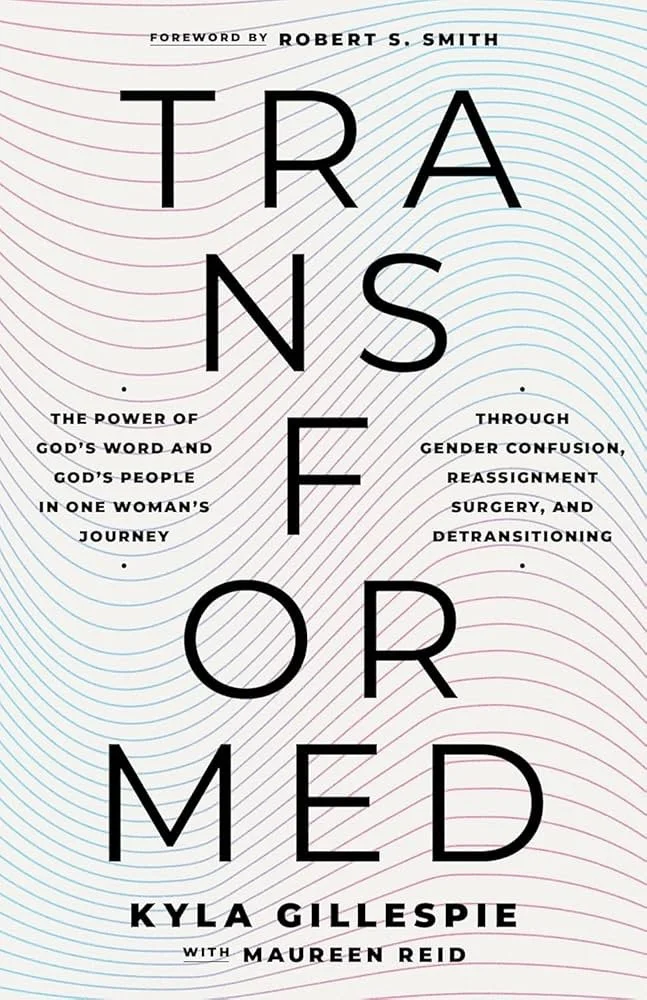
Adapted from TransFormed: The Power of God's Word and God's People in One Woman's Journey through Gender Confusion, Reassignment Surgery, and Detransitioning, ©2026. Used by permission of B&H Publishing.