
The Church as Spring Training
Every spring, we look outside and see the signs of resurrection life as plants sprout and bloom. Every spring, baseball teams prepare for the regular season by playing practice games called spring training. In the same way, Christians are called to practice resurrection in preparation for eternity. This preparation takes place in the local church. In spite of all its faults and flaws, the church is our spring training for the eternal season that lies ahead. If we don’t practice before the season, then we won’t be prepared for life to come.
The church is a Christian’s spring training because the life of Christ is especially present in the church. If we want to see where the risen life of Christ is most present, we don’t look primarily to nature or even to ourselves but to the community Jesus died for. Jesus promised that his resurrection life is especially present in the church: “For where two or three are gathered in [his] name,” the risen Christ is among them (Matt. 18:20). If you want to “get in” on Jesus’s resurrection life, then you need to “get in” the church.
The Scriptures display Christ’s life as the source of the church. When Jesus was crucified, a soldier pierced his side, causing water and blood to flow from it (John 19:34). The water and blood communicate not only Jesus’s human death but also that his death provides life for the world and even produces the church.
The church fathers affirmed that Jesus is the new Adam whose side was opened and that Eve was taken from him (see Gen. 2:21–22). According to the English medieval monk Bede, the bone was removed from Adam’s side while he was sleeping for the sake of a deeper mystery. For it signified that the sacraments of salvation were to come from the side of Christ.[1] The water from Christ’s side represents baptism, while the blood stands for communion. The church is born through the opening of Jesus’s side as they drink of his water and blood.
If the church is birthed from and, thus, connected to Christ, then the primary way we can join Christ in his resurrection is to join a church. If you are not linked to what Christ has produced and purchased, then there is little guarantee that you are in Christ. While you don’t have to go to church to be a Christian (that would make your salvation based on your works), you can’t be a Christian without going to church. And by “going to church” I don’t simply mean attending on Sundays. Attending is too weak of a word. The early Christians didn’t merely attend but devoted themselves to the teaching of the church, the fellowship in the church, the sacraments practiced by the church, and the prayers with the church (Acts 2:42). Historically, therefore, Christians have practiced something that can be labeled “covenant membership.” Paul says we are members of God’s household (Eph. 2:19) and members of Christ’s body (1 Cor. 12:12). Covenant membership is a formal pledge that Christians voluntarily make to God and to one another regarding their spiritual commitments.
Christians do this because the church is the context for resurrection community. It is where we learn to grow into the life to which God has called us. The people of God are the community of the raised. By joining a church, we obey Christ’s call to commit ourselves to his new life and begin practicing heaven on earth, even now. The church is the Christian’s spring training for heaven.
Community of Life and Love
Because you were made for community, the church is the location for resurrection life and love. Humans are biologically hive creatures. We naturally gather together. This reality provides the church with an opportunity, for more than half of Americans report feeling lonely. Almost 60 percent say they eat meals alone and feel that no one truly knows them.[2]Loneliness often contributes to feelings of pain, disappointment, and depression. The rise of loneliness in our modern world is somewhat ironic since we are more connected now than ever before. Given the rise of social media, email, and video calls, we can communicate instantly to people thousands of miles away. It seems that we are connected to everyone but in community with no one. The church is unlike any other gathering on this planet because it is one of resurrection life and love.
First, the church is a community of life because it celebrates Jesus’s resurrection. In so doing, it is a lifeline for Christians. Only those hooked up to this IV will continue to flourish, for the church is the community that has Jesus’s life flowing into it. Jesus said that his life-giving presence is available where two or three are gathered in his name. Even though the church doesn’t do this perfectly, this is what it is called to. The believing community is to be marked by the fruit of the Spirit—“love, joy, peace, patience, kindness, goodness, faithfulness, gentleness, self-control” (Gal. 5:22–23).
Second, the church is a community of love because it revels in God’s love. God showed his love by giving his Son’s life so that we might have life (John 3:16). Notice that the first fruit of the Spirit mentioned above is love. You can’t have life without love, and you can’t have love without life. These are twin concepts in the Scriptures. The two greatest commandments concern love (Matt. 22:37–40), and Paul says that to “put on love” binds us together in perfection (Col. 3:14). When you love others, they flower into the persons God made them to be. Thus, the most important mark of the church is not expositional preaching, covenant membership, or biblical church leadership. The most important mark is love because “God is love” (1 John 4:8).
Thus, Christians are called not only to believe in resurrection doctrine but also to embody resurrection culture.[3] The life and love of the resurrection creates a community of giving, caring, inclusion, and hope:
· Giving. Because of the resurrection, Christians share their possessions, time, resources, and energy. We are to be generous with the life God has given us because he promises that as we give up our lives for his sake, we actually save our lives (Luke 9:24). As we sacrifice, we go from death to life.
· Caring. Because of the resurrection, Christians create communities where our physical bodies matter. This pertains not only to sexual morality but also to providing for one another’s physical needs.
· Inclusion. Because of the resurrection, Christians know that every person matters—from womb to tomb, from male to female, from black to white, from rich to poor, from able-bodied to disabled.
Hope. Because of the resurrection, Christians foster a community of hope. Christians are not a pessimistic people but a happy and hopeful people. We are not to wring our hands about the demise of culture but instead to be a prophetic witness to the presence of the kingdom of God.
[1]Bede, Expositio in Genesim, ed. C. W. Jones, trans Calvin Kendall, Corpus Christianorum Series Latina 118a (Brepols, 1967), 56–57 (1.2.20–22).
[2] “Over Half of Americans Report Feeling Like No One Knows Them Well,” Ipsos, May 1, 2018, https://www.ipsos.com/.
[3] Ray Ortlund, The Gospel: How the Church Portrays the Beauty of Christ (Crossway, 2014).
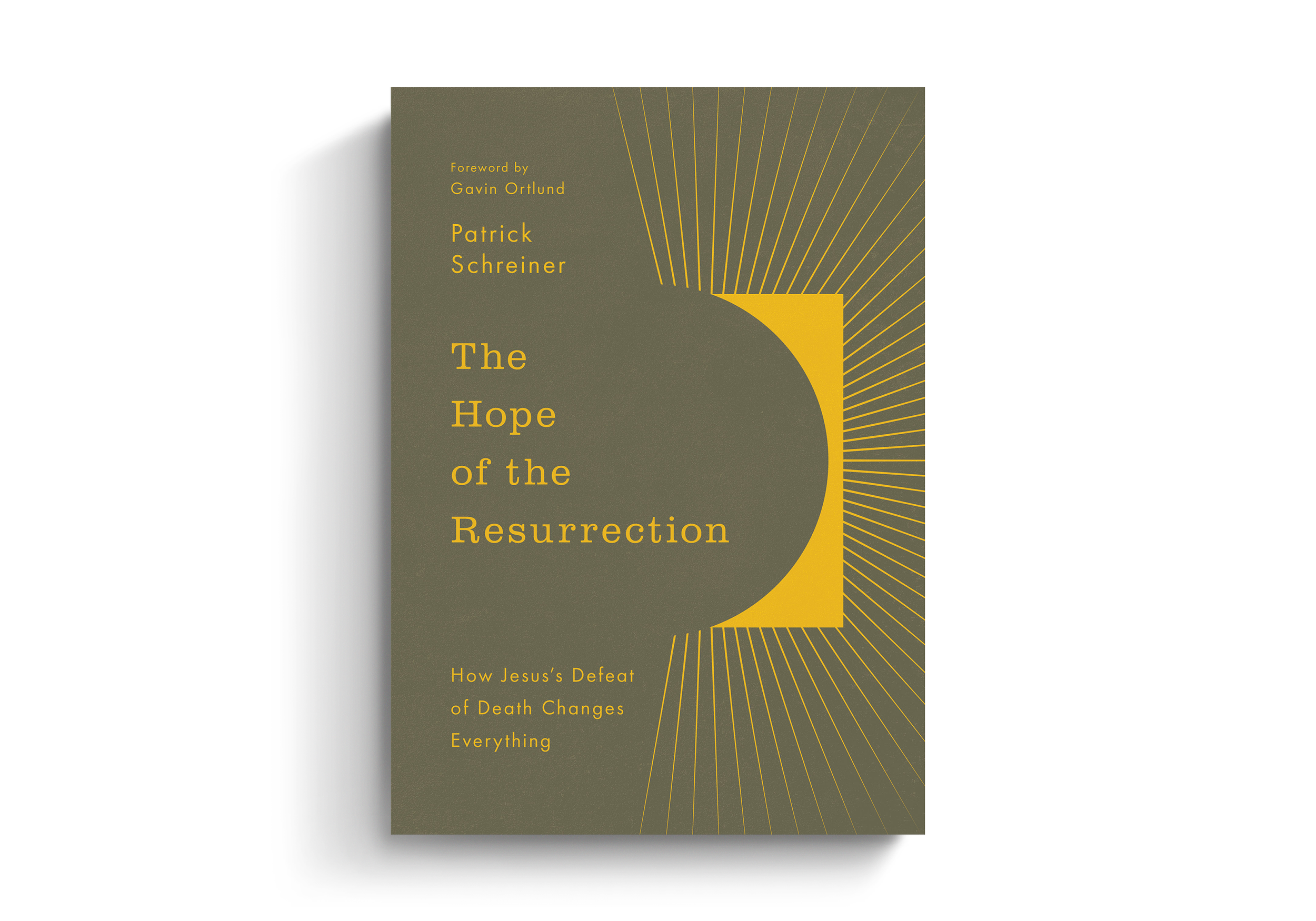
Content taken from The Hope of the Resurrection by Patrick Schreiner ©2026. Used by permission of Crossway, a publishing ministry of Good News Publishers, Wheaton, Il 60187, www.crossway.org.