
God built the Christian life in a way where individual parts make up one communal whole, which means trying to grow in the Christian life—especially in holiness—won’t happen without community involved.
To put it succinctly, to be set apart as holy is not a call to isolation. In fact, isolation is often a scheme of the devil that leaves us vulnerable and susceptible to sin (Prov 18:1). Holiness is something we walk out together, as a chosen, called, united, body of people who belong to God. Simply put, we belong to Him, and we also belong to one another.
There are many significant ways God uses his people to cultivate holiness in one another. We’ll briefly consider three:
Encouragement. Hebrews 10:24–25 says, “Let us watch out for one another to provoke love and good works, not neglecting to gather together…but encouraging each other.” When we gather with other believers—whether in a church worship service, a small group Bible study, or around our kitchen table—we have the opportunity and proximity to remind each other who we are and what we’re called to. Encouragement, for the believer, is more than an “atta girl” or “atta boy”. Biblical encouragement is given to strengthen one’s faith, inspire, persevere, remind them of truth, or call them to obedience. Knowing these goals helps us understand the importance of being in community with God’s people.
Investment. We can invest in others in a variety of ways, but here we’ll look at two: resources and discipleship. As you might be aware, if you’ve read the book of Acts, when the Holy Spirit descended at Pentecost, the New Testament Church, of which we are a part, was birthed. Early apostles, missionaries, and disciples traveled the known world sharing the Gospel and organizing small communities of believers into local churches. It was within these early church plants that God’s people modeled what it looks like to invest in one another. The leaders of this movement—Paul, Timothy, Stephen, Peter and many others—invested through service and discipleship. They taught people about God and shared about the resurrection of Jesus. They ministered, healed, prayed, toiled, and encouraged them; offering themselves as living examples of how to know and serve God. In turn, God’s people cared for them sacrificially from their own resources—opening their homes, sharing their food, serving, protecting, and supporting them. It’s not an overstatement to acknowledge that the church would have failed without the interdependence of God’s people along the way. And, it’s not an overstatement to acknowledge we, too, will fail to display holiness without the building block of God’s people encouraging and investing in us, and us in them.
Humility: Ephesians 4:2–3 tells us to walk “with all humility and gentleness, with patience, bearing with one another in love, making every effort to keep the unity of the Spirit.” Humility is tested and grown in the context of relationships that require characteristics of holiness, like forgiveness, grace, and self-sacrifice. God often uses fellow believers like sandpaper in our lives to smooth the rough edges our own hearts, shaping us to look more like Jesus (Prov. 27:17). If we want to be holy, we must be humble because it is a characteristic of Christ. In Matt. 11:29, Jesus describes himself as “lowly and humble in heart”. The humility of Jesus was lived out against the backdrop of people—disciples, family, fellow Jews, and followers.
God’s people are a sacred, holy community bound together by the Spirit of the Living God. We will find God’s people everywhere we go. But, they are the strongest building block when experienced in the community and accountability of the local church. As plenty of leaders and pastors have said for years now, the church is God’s “Plan A” for his people. And if you’re tempted to think you don’t need a church family to pursue holiness, I want to issue a word of caution. However imperfect the church might be, it is God’s chosen context for transformation. It’s within the family of God and the community of the church that we are called to encourage each other, bear one another’s burdens, and grow together into the holy people God has declared us to be.
God’s Pursuit
For too many years I settled for a lopsided, ineffective spiritual foundation. I was committed to the local church, but spiritually dependent on church leaders and pastors to know God’s Word on my behalf. I enjoyed learning from people who knew their Bibles, but I didn’t desire to be someone who knew my Bible—mainly because if felt very intimidating. As a “people person”, knowing God’s people came easier to me than knowing God’s Word. Because I enjoy people and fellowship, I hosted a Bible study on Sunday nights in my home before I was in the practice of consistently reading my Bible. What an embarrassing sentence to write!
Maybe your story is the opposite. Maybe you know your Bible well enough to teach a class, but you lack Biblical community to encourage and invest in you. Whatever the case, it is easy to walk away from a chapter like this with a spiritual to-do list, as if holiness is up to us—which we’ve already acknowledged, it’s not. Allow me to remind you of a transcendent truth that will span the advice of this book: God is the source of all holiness. And just like God changes our equation of nature vs. nurture, God is also present as we seek to establish a foundation for holiness. The reality is our two building blocks of God’s Word + God’s People = God’s Pursuit of You! Honestly, it’s the best news we could receive. When we read the Bible, in concert with walking alongside a healthy community of God’s people, we aren’t just learning great things and enjoying great people as if we’re taking some sort of fun extracurricular college class—we’re experiencing what it's like to be pursued by God’s presence and walk with God himself. Said another way, God’s Word and God’s people are not our way of going find God; they are his way of coming to find us!
Let me explain.
A Biblical Pattern
From the first pages of Scripture, God’s original design was fellowship with us, speaking with and walking with Adam and Eve in the “cool of the day” (Gen 3:8 ESV). When sin irrevocably fractured that proximity, he didn’t write us off, or abandon relationship with his people. Instead, an epic plan of redemption and reconciliation was set into motion to rescue us from the consequences of the sin that separates us from him. Time and again God has intervened in ways that not only saved us but moved toward us, guiding us with his own presence and power:
He delivered the Israelites from slavery in Egypt and personally guided them through the wilderness in a pillar of cloud by day and a pillar of fire by night (Exodus 13:21).
While in the wilderness, he tabernacled with them in a sacred, portable tent where his glory rested (Exodus 25:8).
He appeared in bodily manifestations known as theophanies to Joshua ahead of the battle at Jericho (Joshua 5), to Moses in a burning bush (Exodus 3), to Elijah on Mt. Horeb (1 Kings 19), and to a stunned King Nebuchadnezzar as he observed the miracle of a fourth man in the furnace with the three he had condemned: Shadrach, Meshach, and Abednego. None of which were burned, by the way (Daniel 3).
He appeared in visions, dreams, and powerful, indescribable, terrifying manifestations that gave us a small glimpse of his majesty: hiding Moses in the crevice of a rock while his glory passed by (Ex. 33), revealing himself high and enthroned to the prophet Isaiah in a vision (Is. 6), and allowing his glory to fill the temple of Solomon so thick that the priests couldn’t minister (1 Kings 8).
And then one day…Emmanuel, God with us! The incarnate Christ, the Son of God, came to dwell among us. John 1:14 says, the “Word became flesh and dwelt among us. We observed his glory, the glory as the one and only Son from the Father, full of grace and truth.” For almost 33 years God walked the earth in the person of Jesus in pursuit of us—“to seek and save the lost” (Luke 19:10). Jesus was (and is) God with skin on. He entered the chaos of our world, broken by sin, on a rescue mission that resulted in Jesus giving his life to reconcile us back to the Father. Through his death and resurrection, he removed every barrier that kept us apart.
“Okay, yes. Jesus came near. But that was two thousand years ago,” you might be thinking. “What about now”?
Friend, God was not done coming near us. Once the resurrected Jesus ascended to heaven and took his seat at the right hand of God, the Father, the Holy Spirit was sent to dwell with his people once again—only this time he isn’t just with us. He comes even closer by dwelling in us. Let this truth sink deep into your heart: God has a long history of moving toward you. Did you know that even before we receive the gift of salvation, it is God’s Spirit that awakens us to our sin and need for redemption (John 16:8)? Anything sanctifying we do is a response to his pursuit of us.
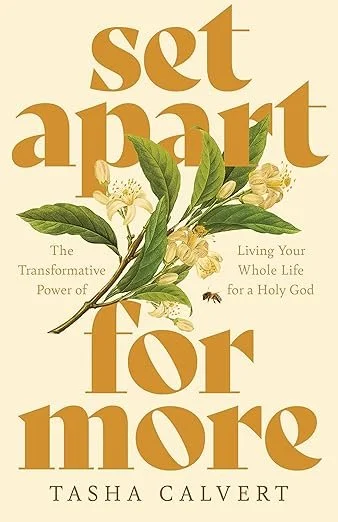
This is an excerpt from “Set Apart for More: The Transformative Power of Living Your Whole Life for a Holy God” by Tasha Calvert, released by B&H Publishing Group.