
This is not a book about suffering. Or it is not just a book about suffering. It’s not even primarily focused on suffering, although various forms of suffering do provide the backdrop for everything I’ll discuss.
This book is about the end of everything, and how this end that Christ will bring grounds the hope of all believers. This book heralds the hope of the great reversal, the day when the last shall become first and the first shall become last, and it celebrates a day so important that two biblical authors simply refer to it as “the Day” (1 Cor. 3:13; Heb. 10:25).
But trust me, if there was one topic I wanted to write about even less than suffering, it was the end times—the return of Christ and our final destinies. For many Christians my age, these ideas often seemed odd or even off-putting when we were growing up. I remember, as a middle schooler, encountering two broad groups: On the one hand were a few outspoken Christians who passionately talked about the end times, often with detailed charts, references to oil prices, and conflicts in the Middle East. Their enthusiasm was sincere, though their approach sometimes felt overwhelming or difficult to relate to. Then on the other hand were faithful, everyday believers who either didn’t emphasize those same verses from Ezekiel or preferred not to speak about them much at all. (Of course, I’m simplifying here; our adolescent impressions rarely capture the full picture.)
Please don’t judge me, but this admittedly flawed dichotomy between the two types of Christians lingered too long in my Christian life, lasting throughout high school and college. I distinctly remember sitting in a dorm room with some friends when one guy said, “I just heard a pastor talking on the radio about Revelation and how the flying grasshoppers are helicopters, and in the coming war, two-thirds of us are going to die.”
I looked around the small dorm room, six of us sitting on chairs, a futon, and bunk beds. We all wondered which four wouldn’t survive until our graduation.
When one puts these kinds of teachings about Revelation alongside the continual trickle of religious teachers predicting the exact date of the apocalypse, it is easy to become suspicious toward teaching about the end times, if not disillusioned and cynical, especially when the predicted dates come and go. While delivering in sales, books featuring the four horsemen of the apocalypse on their covers have failed to deliver the imminent conclusion they’ve promised. I resonate with the sentiment of theologian Kim Riddlebarger, who described what he would not include in his book about understanding the end times: “This study will not attempt to find biblical texts that explain current events in the Middle East,” he writes. “I will not evaluate the potential Antichrist candidates. Nor will I discuss how rapidly developing technology is preparing the way for a totalitarian world government” (A Case for Amillennialism, 28). In other words, he would not include the very elements most readers want in a book about the end times. And neither will I. I have something better.
But that’s getting ahead.
My impressions regarding end times frenzy faded during my time at seminary, but the focus returned slightly during my early pastoring years. This time my interest in the return of Christ developed in a calmer and more nuanced manner. When I began the ordination process in my church denomination, issues related to the end times featured more prominently than any other doctrine. Around the same time as my ordination exams, the denomination changed one word in our statement of faith in the section about the end times. The sentence previously read, “We believe in the . . . premillennial return of our Lord Jesus Christ.” We replaced the word premillennial with glorious, so the sentence now reads, “We believe in the . . . glorious return of our Lord Jesus Christ.” This change allowed for other, yet still orthodox, views of the return of Christ. Since all believers recognize the return of Christ as glorious, that adjustment provided a relatively simple and clean update.
Not every pastor in our denomination viewed the change positively, however. The controversy surrounding this change complicated my ordination process. To spare you the suspense, both my forty-page paper and my five-hour oral examination went well. I became the first pastor in the seventy-year history of the Evangelical Free Church of America to be ordained with an amillennial view of the end times.
I’m bringing all this up here at the start of this book because I want you to know this experience changed me—for the better. Preparing for a scrutinized ordination process meant spending years poring over the details of various understandings of the end times. For me, however, this study created not primarily an academic interest in the end times but a pastoral one: the concern that understanding the end times should shepherd Christians into full maturity in Christ. The biggest and brightest truths about the return of Christ (not the debatable aspects) became the biggest and brightest truths in my heart. My writing started to change. My pastoring began to change. My view of suffering changed. Life became more hopeful.
Perhaps you’re reading this because you are interested in the different perspectives on Christ’s return. You already know quite a bit about dispensationalism, historic premillennialism, amillennialism, and postmillennialism. Maybe you share my belief in amillennialism yet find yourself in a church and Christian community that considers amillennialism sketchy, as the view sometimes receives criticism for taking too many liberties with passages better understood more literally. Or maybe you’re reading this book without any knowledge of these -isms, other than your awareness people often talk about them with raised voices and elevated blood pressure.
This book aims to help. I don’t intend to explain all the different views, though. Sometimes the best way to help requires adding more than knowledge. Understanding of the end times comes to us best when driven not merely by academic passion but by a pastoral one. If we can parse all millennium mysteries and fathom all tribulation knowledge but have no love for why God promises to do all he promises he will do, then our knowledge is nothing.
Pastor and author Jared C. Wilson has expressed his conviction that “God will not become your only hope until he becomes your only hope” (The Prodigal Church, 212). Wilson writes with intentional redundancy. He believes God often becomes most real to us when we most need him, when one form of suffering or another strips us of the illusion of self-sufficiency. The biblical writers understood this. In just the twenty-seven books of the New Testament, the various authors mention or allude to the return of Christ over a hundred times. To meet suffering believers in their pain, they continually held out the promise of Christ’s return. In short, with suffering as the backdrop, they viewed the return of Christ as the ending that brings the best beginning, the start of the ultimate happily ever after.
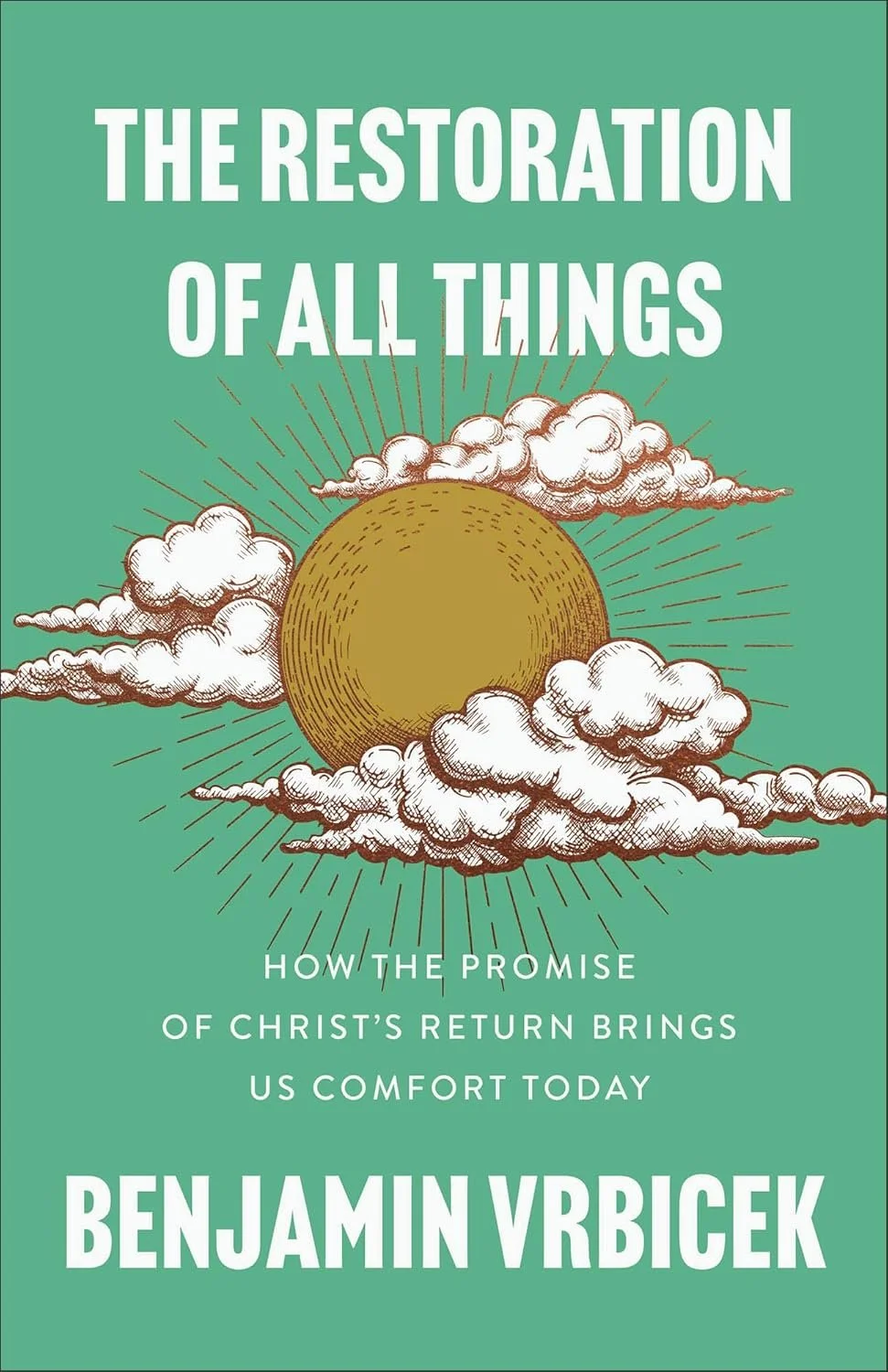
Excerpted from Benjamin Vrbicek’s book The Restoration of All Things: How the Promise of Christ’s Return Brings Us Comfort Today (Baker Books, a division of Baker Publishing Group, 2026). Used with permission.