
“This was all a part of God’s plan.” I believe this is one of the most well-intended but totally unhelpful notions offered up to the grieving, especially those with invisible grief. Many don’t realize what they’re actually saying when these words come rolling off the tongue. We don’t stop to consider that brokenness was never God’s desire. That when God created in Genesis 1, He actually said it was “good.” If God needs to bring about bad, in order to accomplish good, there are fundamental issues with the perfect character of God, not to mention our ability to trust Him. So, do we have a cruel God who is bringing pain and grief in order to accomplish His plans, or could it be that we have a broken and cruel world that has gone completely sideways?
The answer to the question above will dramatically shape the way we live with, and think about, both our relationship with God and our grief. Stay with me for a minute while we go back to the beginning in Genesis 1, God creates everything and He declares without hesitation that it is good. What we see, at least for a span of time, is creation living in perfect harmony, exactly as intended. No violence, no pain, no offense, absolutely no brokenness whatsoever. God walking with humanity and humanity walking with God, as the creator intended (Gen. 3:8). All is well, and then the serpent appears. As we talked about briefly before, Satan in the form of the serpent, is able to plant a seed of doubt in Eve’s mind. “Did God actually say?” (Gen. 3:1). As Eve processes, Satan offers his own conclusion: “You will not die. For God knows that when you eat of [the tree] your eyes will be opened and you will be like God, knowing good and evil” (Gen. 3:4-5). As Adam and Eve both eat of the fruit, everything changes. “Then the eyes of both were opened, and they knew they were naked” (Gen. 3:7). What once was perfect and good is no more. A life for humanity in perfect communion with God, full of ease and endless joy, now marred by sin that brings pain, sorrow, and doubts into the equation.
The effects were immediate and widespread.
The Lord God said to the serpent, “Because you have done this, cursed are you above all livestock and above all beasts of the field; on your belly you shall go, and dust you shall eat all the days of your life. I will put enmity between you and the woman, and between your offspring and her offspring; he shall bruise your head, and you shall bruise his heel.”
To the woman he said, “I will surely multiply your pain in childbearing; in pain you shall bring forth children. Your desire shall be contrary to your husband, but he shall rule over you.”
And to Adam he said, “Because you have listened to the voice of your wife and have eaten of the tree of which I commanded you, ‘You shall not eat of it,’ cursed is the ground because of you; in pain you shall eat of it all the days of your life; thorns and thistles it shall bring forth for you; and you shall eat the plants of the field. By the sweat of your face you shall eat bread, till you return to the ground, for out of it you were taken; for you are dust, and to dust you shall return.” (Gen. 3:14-19)
God has never been cruel to humanity, quite the opposite. We have been cruel to the creator; we reached for what wasn’t ours. Like a bratty child discontent with their meal, we pounded our fork on the table and yelled, “We want more!” We are fully responsible. Humanity ushered in the pain, the brokenness, and, in turn, the grief that would follow. Why would God allow this? God didn’t prevent it because to do so would be to force submission in the relationship, and there is no love in that. No, God is not cruel in His allowance of a broken world, filled with broken hopes, broken dreams, broken good desires, but He is absolutely grieved by it. Not a single tear cried, a single knee skinned, or a single love lost was ever a part of His plan, but in His unmatched, long-suffering, perfect love, all is not lost. Wrapped up in the consequences of sin is a promise that will allow goodness and purpose like a bright beam of light to break through the darkness. Did you see it?
I will put enmity between you and the woman, and between your offspring and her offspring; he shall bruise your head, and you shall bruise his heel. (Gen. 3:15)
As soon as things go sideways, God makes it clear that He has a plan to put everything back in order. It won’t come through a bolt of lightning, a reset of humanity, or a divine re-ordering of creation, it will come through this unnamed “He.” Who is this He that will crush the head of Satan, putting death to death once and for all? Jesus. In God’s sovereignty, although pain, suffering, and sorrow were never in the plan, He already had a perfect way to bring His kids back home. Cruel God or cruel world? In the words of one of my favorite folk singers Stephen Wilson Jr., “God is good, life is twisted.”1 We ushered in a cruel, broken world, but thank goodness we have a good God who wasn’t caught off guard. A God who is able and willing to bring purpose to even our deepest and most draw-out pain.
I’d be lying if I said I knew all of the reasons for your grief or how God is using or will use it for good. I don’t; no one does. We don’t have all of the answers and although it’s painstakingly difficult, we need to become okay with that. Spurgeon’s words remind me of this, “God is too good to be unkind, and He is too wise to be mistaken. And when we cannot trace His hand, we must trust His heart.”4 I believe there are some foundational purposes that God can bring out of whatever storm we face. I believe this because it is always God’s desire to see us grow to be more like Jesus. Here are a few of those, although this list is not exhaustive:
To grow us in maturity
To build perseverance
To grow us in holiness
To help us uniquely encourage and support others
To wean us off self-reliance
To strengthen our assurance in Christ
To glorify God as we persevere
Could it be that, as my close friend Justin Holcomb shared with me, “God is so sovereign and creative that He can bend brokenness into a tool of blessing?” We see this time after time throughout the Bible. We see this with healing after healing. We see this as Jesus casts out demons. We see this with the infertility of Abraham and Sarah, and Zechariah and Elizabeth. We see this through Moses’ speech impediment, through Mephibosheth’s inability to walk, through the Apostle Paul’s thorn in the flesh that never leaves him. We see this with Joseph and the evil of his brothers; we are reminded of both a broken, cruel world, but also an unthwarted God. Joseph said to his brothers, “As for you, you meant evil against me, but God meant it for good, to bring it about that many people should be kept alive, as they are today” (Gen. 50:20). Time and time again, God doesn’t work around the pain and brokenness, but through it.
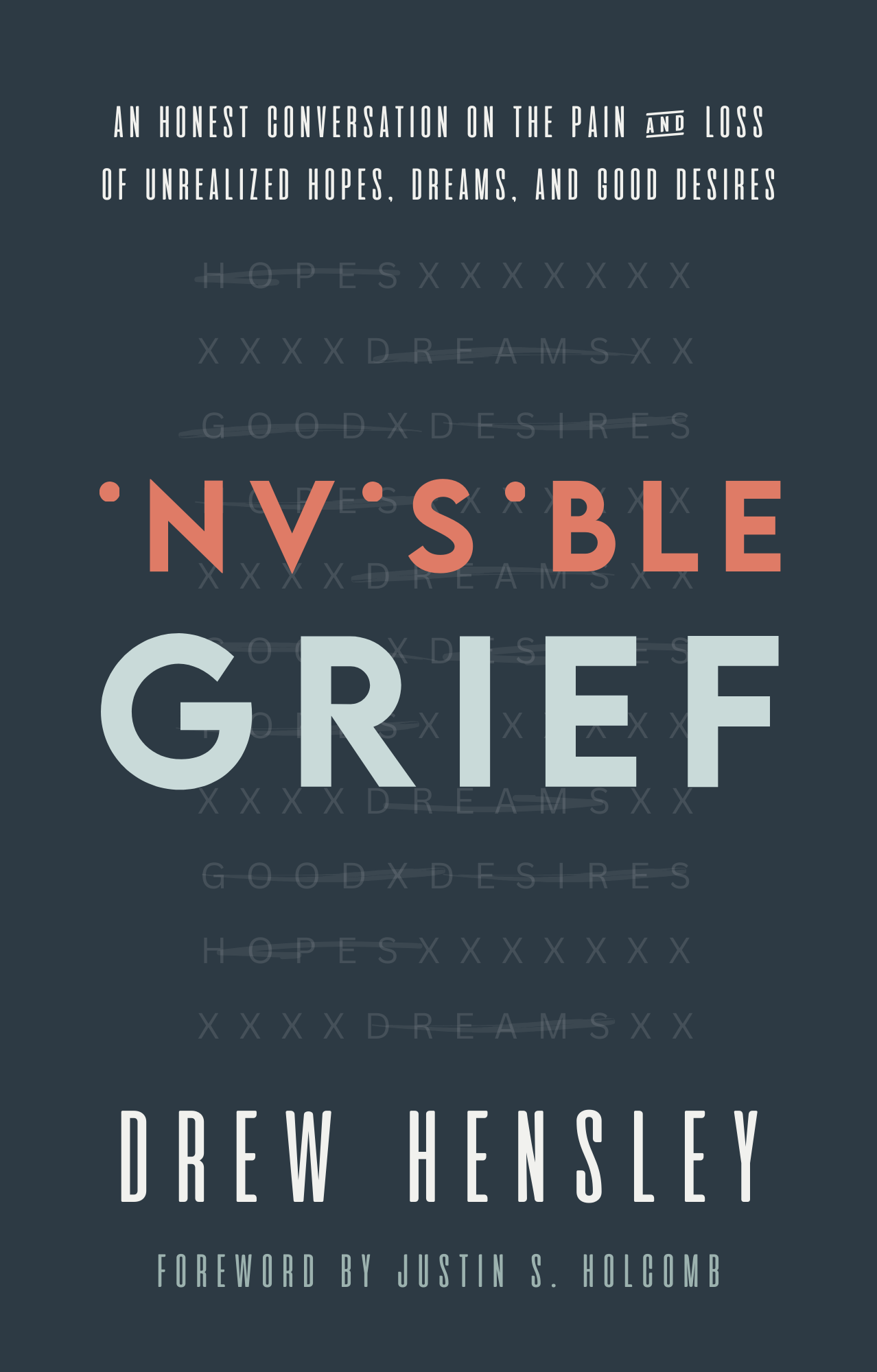
This excerpt is from Invisible Grief: An Honest Conversation on the Pain and Loss of Unrealized Hopes, Dreams, and Good Desires by author Drew Hensley, published by Christian Focus.