
Nearly every week, I (Vick) benefit from working with different churches to help them create and implement their disciple-making vision and strategy. That’s the goal of Replicate Ministries, an equipping organization that Robby and his wife Kandi started in 2008 to help churches activate their unique disciple-making movement. We provide coaching, consulting, and resources to hundreds of churches every year of all sizes, demographics, and denominations, working closely with their leadership to ensure the vision will thrive in their context.
The transformations we’ve seen have been unbelievable, watching pastors rediscover a passion for ministry while watching disciple-making in their church thrive like never before.
But I must confess, there was a time when even after spending fifty to one hundred hours with a leadership team, giving them everything I had to offer and trying to answer every question they had, I still didn’t know if they were movement-ready. I was always hopeful, but I wasn’t always confident.
So in 2020, Robby and I went back to the drawing board. We got together and asked, “What makes the difference between the teams that succeed and those that don’t?” As we worked, we began noticing common themes, starting with our own failures and then looking at the hundreds of churches we’d trained. Equipped with this fresh learning, we built upon the solid foundation for our first tool kit, making some essential expansions to it.
Because while every church movement shares essential elements, their expressions are different. The early church’s movement was unique. Long Hollow Church’s movement is unique. Your movement will be unique. You may have a congregation of a hundred or a thousand. Your church may be more rural or more urban. You may be Presbyterian, Methodist, Baptist, or nondenominational. The goal isn’t to make you like Long Hollow, or like Replicate, or like the church down the street. The goal is to help you be who God calls your church to be.
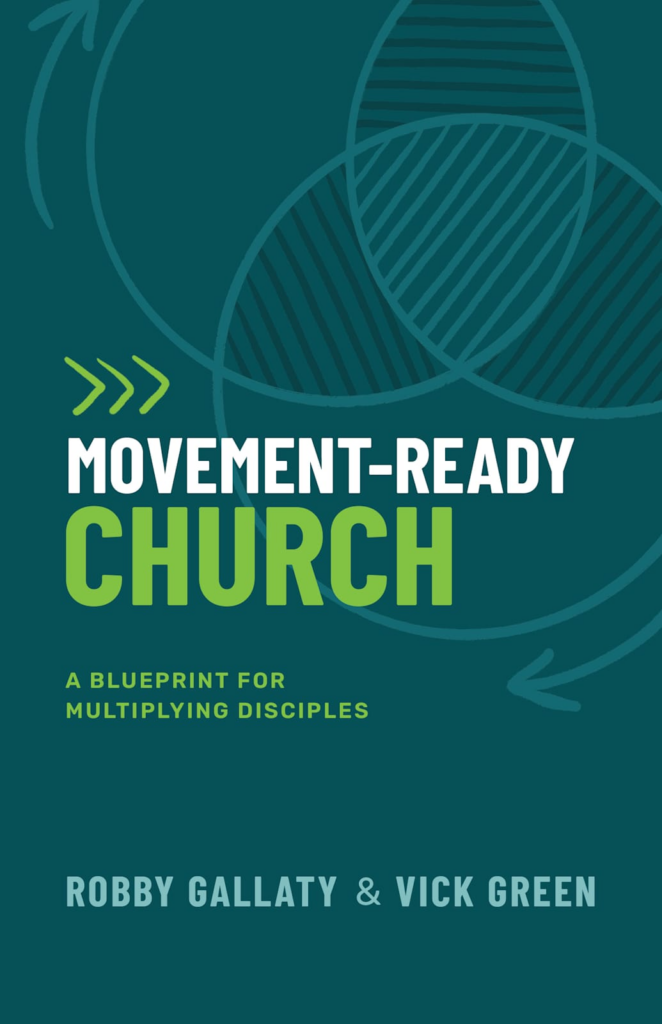
The plan we’re going to share with you—our Toolkit 2.0—is designed to help your church activate your unique disciple-making movement. We’ve built it around a simple, foundational tool, called the Movement-Ready Church, that identifies three essential elements every church needs for putting the pieces together and watching their movement happen.
Spiritual Renewal: What starts and sustains your movement
Often, church leaders gravitate toward planning more than praying. But it’s not an either/or. The strategic and spiritual elements of pastoral leadership are friends, not enemies. God has called us to plan and to strategize, yes, but the spiritual aspect must come first because a move of God is received, not achieved. The movement you want to see in your church starts not with a marker in front of a whiteboard but on your knees, with your face down. That’s why the first and most essential element in a church’s mission of disciple-making is spiritual renewal.
This is all about what is happening in the hearts of the church’s leadership. It connects their intimacy with Jesus with their ministry activity. You can think about it this way: Before we look for others to change, we must first look at what needs to change in us. There must be what we call a “desperation in me.”
To activate your disciple-making movement, you must get to the end of yourself, where you’re not relying on your own charisma, the newest program, a bigger conference, or a silver-bullet strategy. Spiritual renewal is all about the leadership team fostering an insatiable hunger for more of God, both for themselves and for their people. As they desperately pursue God, a ripple effect will spread through the church.
Disciple-Making Culture: What shapes your movement
The second thing your church must have is a disciple-making culture. While spiritual renewal can bring a move of God, it requires disciple-making to become a movement of God. Seeking God and desiring more of him will always guide your leadership to return to what he’s called the church to do from the beginning: to go and make disciples. If spiritual renewal is all about “desperation in me”, disciple-making culture is all about “dedication to the few”— to the life-on-life nature of discipleship that Jesus modeled for us.
For many, this idea of focusing on the few is a dramatic shift in their church’s philosophy and leadership mentality. But to lead our churches well, we must be committed to not only the words of Jesus but to the ways of Jesus, or else something will always be missing. It isn’t enough to just grow a church; we must ensure that its growth lines up with the heart of God and the ways Jesus has modeled for us. If we want to see the blessings of Jesus’s ministry, we can’t separate ourselves from the method Jesus gave us.
When Jesus measures the health of a church, he doesn’t count the people in it; he weighs them—meaning, the depth of your disciples is more important than the breadth of your ministry. We must always make sure the growth we’re experiencing is not just the result of making converts or program attenders. Instead, it’s the kind of growth that comes from making disciples who can make other disciples.
Organizational Clarity: What spreads your movement
Lastly, your church must have organizational clarity. We’ve talked about having “desperation in me” and “dedication to the few.” Organizational clarity is all about your “declaration for the many.” As your church grows, you must create the words that capture your heart as a leader and communicate it in a way that resonates with your people. You must communicate the why, how, and whereof your movement clearly enough to help people catch the vision you have for your church.
Organizational clarity is what spreads your movement. Once you grow beyond the first thirty people in your church, clarity becomes crucial. When the group is small, the people who directly spend time with the leader catch the vision merely by proximity. Through dialogue and living in community with one another, the church can capture the spirit of the vision and join in. But as the church grows, the gap widens between the vision the leader has and the vision the church catches.
Your church’s vision is a leader’s greatest sermon. If your vision is misty among your leadership team, you can be sure it’s a total fog to your people. Leaders must create organizational clarity to close that gap. Finding the right words that don’t just resonate deeply in the leader but give clarity and direction for the staff and congregation is crucial. If everyone in the church doesn’t have clarity on these things, everyone is left feeling confused and frustrated. And the church feels stuck.
As the attendance and complexity of your church increase, you must regularly keep evaluating your message because the level of clarity you needed to get where you are today won’t be what you need to get where you want to be in the future.
Robby and I believe the local church’s purpose is to “make Jesus’s final words their first work”-- his well-known final words from Matthew 28:19, “Go therefore and make disciples of all nations.” When the church prioritizes this purpose, a movement can be started.
We see it happening, of course, with the early church in the book of Acts, as the disciples immediately responded to his final words, resulting in a movement that formed and spread from Jerusalem to the ends of the earth.
The movement they experienced had specific elements that were unique to its people, time, and place. So will yours. You're not dealing with the same cultural battles the disciples faced, and you may not see the same numerical growth they did. But you do have the potential for a disciple-making movement that spreads throughout your entire congregation, community, and beyond.
Adapted from Movement-Ready Church: A Blueprint for Multiplying Disciples, ©2026. Used by permission of B&H Publishing.