
Created to Play
“What do you do?”
The question tumbles off the tongue as the script we must rehearse with every new acquaintance. Those four little words act as the gateway to knowledge of who we are, but are they successful?
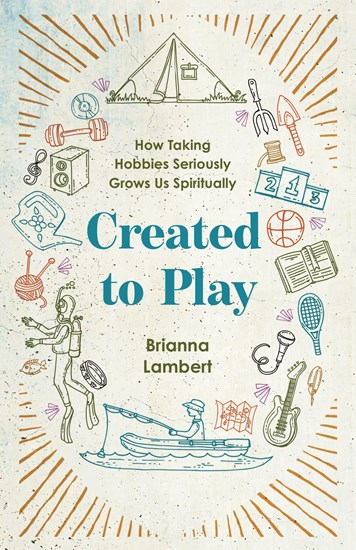
We might rattle off an occupation that provides a list of rough skill sets, but these reveal only one part of our nature. You and I are far more complex. Beyond the vocational callings of engineer, minister, analyst, teacher, or plumber, we take on a host of different titles. We tie back our apron to transform into a chef at the stove, or we sink our knees in the dirt and become a gardener. The winding road beneath our tires names us a cyclist, and the Friday night movie converts us into a film critic.
In the midst of our play, we become needle workers, athletes, collectors, sculptors, bakers, designers, baristas, and a hundred more names beyond. These titles usually don’t make it into our introductions. We aren’t as quick to bring up the puzzles that enliven us after a long day at work or the quiet thrill we get from an art museum. Instead, our avocations live in the shadows of more “meaningful work.” But what if I told you those activities matter too? What if your hobbies weren’t arbitrary passions at all but the purposeful design of the God who formed every part of you? What if your favorite form of play is one more way to worship the God who made you?
Too often, we believe the lie that play is a distraction from the important work of life. This way of thinking plagued my own mind for many years. It yoked me with fear and prompted me to draw lines between the responsibilities of my life and all other activities that felt too enjoyable to be part of my calling as a Christian. My love of baking, camping, or a good movie were relegated to diversions I’d squeeze into the empty spaces of my life and call “rest.”
Then something changed. The more I grew in my understanding of the God “by whom everything exists,” the more I began to see that my arbitrary lines were foolish (Hebrews 2:10). God makes no such distinctions. Instead, “He is before all things, and in him all things hold together” (Colossians 1:17). He proclaims every good and perfect gift comes from his hand (James 1:17). Our days aren’t separated into important work and frivolous play—it’s all God’s world and all his gifts.
After all, from the beginning work and play were created to walk hand in hand. Adam’s task of naming the animals required effort, creativity, and perseverance, and he delighted in every minute of it. The cultivation of the earth was meant to be lived out with deep joy and passion. Our God modeled the same—delighting in his created work and rejoicing over the redemption of his beloved children with song (Zephaniah 3:17). The fall brought thorns and thistles of difficulty that section off what we must do from what we want to do, but one day when the Lord returns, we will inhabit a world where work and play are once again married in perfect harmony (Revelation 5:9-10).
This means we can fulfill our purpose not only in our vocations but also in our avocations. We can labor and cultivate the earth through our nine-to-five, and come home and sit with an instrument and continue to do the same. We can fulfill our God-given purpose in the cubicle and across the table with a board game, because you and I were created to play. Scientists admit that of all creatures, humans play the most, noting, “We are built to play and built through play” (Stuart Brown, Play: How It Shapes the Brain, Opens the Imagination, and Invigorates the Soul). And God does just that. He builds us through our hobbies and gives us his own titles: We’re not only bakers kneading a lump of dough, but Nourishers filling up the image-bearers around us. We’re not just a guitarist, but the Herald of the true king as every finger plucks the string. We might call ourselves a hiker or a camper, but when we hit the trail we become Beholders of our Creator’s glory. No matter if we’re training a puppy or restoring an old, beat-up Chevy, God is quietly using our particular passions to mold us into the sons and daughters he created us to be.
Maybe we need to spend more time asking each other, “What do you play?”
Just Play
In many ways, it’s never been easier to play. Thanks to the internet, many long-forgotten hobbies have resurfaced. Facebook groups teach us the art of soap making, food preservation, or leather crafting. Online influencers instruct us in sourdough bread, and an extensive list of Masterclass courses waits to be added to our cart. Mass distribution of goods makes new hobbies even easier to start. Want to learn cake decorating? In two to four hours, decorator tips and parchment bags can show up in a brown smiling box at your doorstep. Thinking about photography? Scroll through dozens of cheap lightboxes, filters, and flashes that are only a click away. In short, hobbies are trending and we’re all jumping on board.
Unfortunately, we struggle to enjoy our play the way God intended. Some have posited that Americans “work too hard at play, a sure sign that they are not very good at it” (Bruce C. Daniels, Puritans at Play: Leisure and Recreation in Colonial New England). Our hobbies quickly become another sphere for us to master: We run to reach our goal weight or turn our craft project into a side hustle. Instead of delighting in play for the gift that it is, we’re tempted to strive after the results it will provide. How often have we told someone, “You should start a business!”? The well-meaning encouragement betrays the belief that play’s value exists only as far as it’s useful.
This isn’t novel. Decades ago, German philosopher Josef Pieper faced the same utilitarian worldview in his postwar society. He begged his countrymen to reinstate the place of leisure for its own sake, challenging them to decide whether a full human life could be grasped as a “worker and nothing else” (Leisure: The Basis of Culture). Many today answer this kind of burnout with the solution of self-care. They tell us to pick up a hobby to quiet our anxieties and rest our minds, but even these calls miss the mark. If the point of that one hour of self-care is to refresh us enough so we’re able to produce more efficiently in the remaining twenty-three, then self-care has just become another satellite in a works-oriented orbit. Moreover, the secular form of self-care continues to train our focus inward, elevating the self while veiling the opportunities for worship inherent in our leisure.
God created our hobbies for far richer purposes than these narrow perspectives. He created us to delight in play not in order to prove our worth but to humbly look upon his. We enjoy hobbies not to craft an identity but to remind ourselves of the one we already hold as God’s children. When we hit the trails solely for the love of it, push our hands against a ball of clay, or spend an afternoon organizing a collection of playing cards, we’re stepping out of our work-oriented mindset and into a posture primed for worship. Because play isn’t about what we accomplish; it’s about who we become in the process.
Taken from Created to Play by Brianna Lambert. Copyright (c) 2026 by Brianna Janelle Lambert. Used by permission of InterVarsity Press. www.ivpress.com